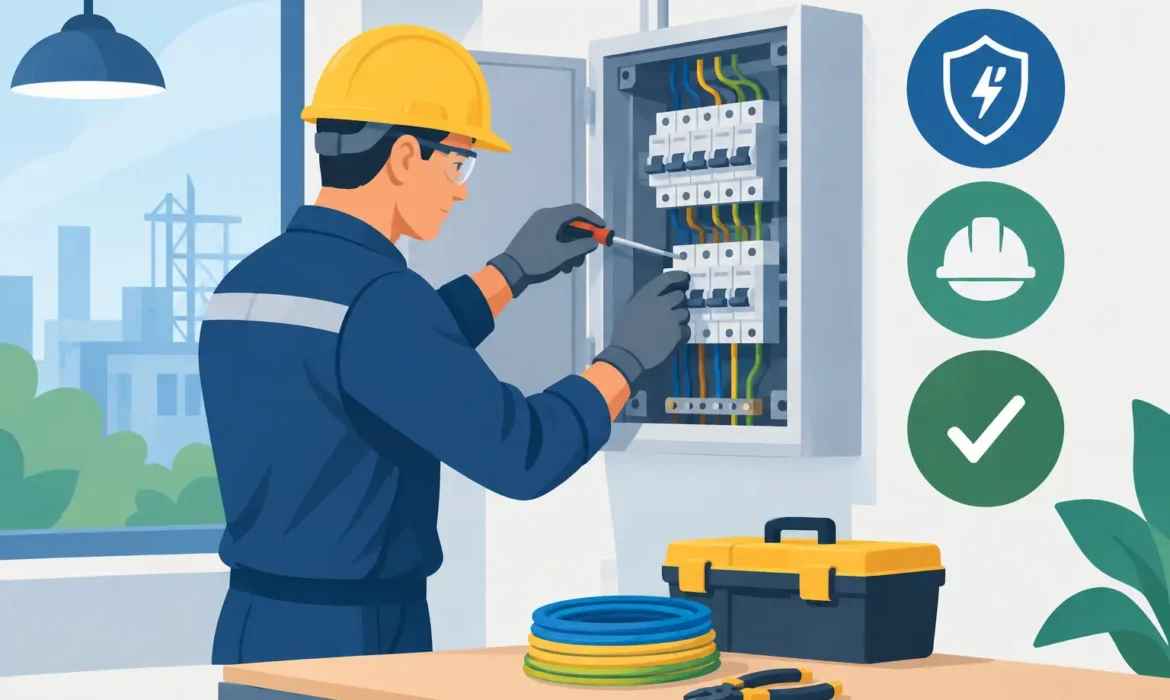
A production line stops, an office loses critical systems, or a renovation handover is delayed because a circuit was not properly assessed. These are not minor electrical issues. They are operational risks with consequences for people, schedules, assets, and regulatory obligations. Electrical works – safe and compliant electrical solutions – require more than a team that can install cables or replace a distribution board. They require competent planning, qualified personnel, disciplined execution, and records that show the work was completed correctly.
For employers managing commercial buildings, industrial facilities, construction sites, warehouses, and plant operations in Singapore, electrical safety must be treated as part of day-to-day business continuity. The right approach protects workers while helping projects stay productive, cost-effective, and ready for inspection.
Why electrical compliance affects more than safety
Electrical systems support nearly every critical business function: lighting, machinery, access control, ventilation, pumps, IT infrastructure, refrigeration, fire protection interfaces, and process equipment. A defect in one area can affect an entire operation. Improvised connections, overloaded circuits, damaged insulation, poor earthing, or unapproved modifications can create shock, arc-flash, fire, and equipment-failure hazards.
The immediate risk is injury or property damage. The wider risk is disruption. A facility manager may face unplanned shutdowns, emergency repair costs, tenant complaints, missed production targets, or questions from clients and authorities about whether the site was properly controlled. For construction and fit-out projects, defects discovered late can delay testing, inspection, and handover.
Compliance is therefore not a paperwork exercise. It is evidence that the electrical installation, the people performing the work, and the work process are suitable for the site. Requirements differ according to the premises, supply arrangement, voltage level, equipment, and scope of work. A straightforward office lighting upgrade does not carry the same controls as work on industrial switchgear, motors, pumps, or a live operational plant.
Start electrical works with a site-specific plan
Safe electrical outcomes are usually decided before work begins. A dependable contractor or project team first establishes the existing site condition, intended load, interface points, access constraints, shutdown requirements, and whether live electrical sources may be present. This prevents a common problem in renovation and maintenance work: discovering undocumented cables, undersized circuits, or incompatible equipment after ceilings, floors, or walls have already been opened.
Define the scope, load, and interfaces
The scope should clearly identify what is being installed, altered, isolated, tested, or removed. For a commercial fit-out, this may include lighting circuits, power outlets, data room requirements, emergency lighting, air-conditioning interfaces, and electrical provisions for tenant equipment. In an industrial setting, it may involve motor control panels, pumps, hydraulic equipment, control systems, or temporary power arrangements during maintenance.
Load assessment matters because adding equipment without reviewing available capacity can overload circuits or protective devices. It also helps teams select suitable cable sizes, containment, protection settings, and distribution arrangements. Where multiple contractors are operating, interface planning is equally important. Electrical work often overlaps with ceiling installation, mechanical services, fire protection systems, flooring, and painting. Clear coordination reduces rework and prevents damage to completed installations.
Assess risk before workers are exposed
A proper risk assessment should address the actual tasks, not rely on a generic form. It should consider potential contact with energized components, isolation and lockout procedures, work at height, confined spaces, wet environments, temporary supplies, lifting of heavy equipment, and access around panels or switchrooms.
Controls must be practical. If equipment must be isolated, the responsible persons need to know who has authority to isolate it, how isolation will be verified, and how the system will be safely returned to service. When shutdown is not possible, the risk profile changes significantly and work must be evaluated with greater technical and safety control. No commercial deadline justifies exposing workers to preventable electrical danger.
Competent manpower is central to safe electrical works
Electrical work should be assigned according to the complexity and legal requirements of the task. Employers should verify licenses, trade qualifications, relevant site experience, and familiarity with the equipment involved. In Singapore, work that requires a Licensed Electrical Worker must be handled through the appropriate qualified professional. Engaging unqualified personnel for regulated work may appear cheaper at the start, but it can create expensive rectification, compliance, and liability issues later.
Competence also includes the wider project team. Electricians need dependable supervision. Safety coordinators need to understand the task sequence. Project managers need to schedule outages and inspections realistically. General workers supporting cable pulling, housekeeping, or material movement need clear boundaries so they do not interfere with energized or incomplete systems.
For employers facing urgent manpower needs, the objective is not simply to fill a headcount requirement. It is to deploy people with the right technical capability, work attitude, and site readiness. This is particularly relevant during plant shutdowns, office reinstatement, industrial maintenance, and high-volume construction periods, where rushed deployment can lead to shortcuts.
Electrical works: safe and compliant electrical solutions in practice
A compliant electrical project follows a controlled sequence from preparation through maintenance. The details vary by site, but four operating disciplines consistently make a measurable difference.
- Controlled installation: Cables, conduits, trunking, panels, and accessories should be installed to the approved design, protected from physical damage, and labeled where necessary for safe operation and future maintenance.
- Safe isolation: Before work begins, circuits and equipment should be isolated, secured against unintended energization, and tested using suitable methods. Workers should never assume that a supply is dead because a switch has been turned off.
- Testing and commissioning: Electrical installations need appropriate inspection and testing before handover or re-energization. Testing verifies that protective measures, connections, polarity, insulation, earthing, and functional controls perform as intended.
- Documentation and handover: Updated drawings, test results, equipment information, maintenance guidance, and records of changes give facility teams the information needed to operate the system safely after contractors leave the site.
These disciplines are connected. Testing is less meaningful if the installation cannot be traced to approved drawings. Documentation is less useful if changes were made without site supervision. A reliable project partner maintains control across the full chain rather than treating installation, safety, and handover as separate responsibilities.
Maintenance prevents small faults from becoming outages
Electrical compliance does not end at project completion. Buildings and plants change over time. Equipment is added, cables are disturbed during renovation, environmental conditions affect components, and repeated loading places stress on connections and protective devices. A planned maintenance program can identify issues before they disrupt operations.
The right maintenance frequency depends on the equipment, operating hours, environment, criticality, and manufacturer guidance. A clean office environment may have different needs from a humid processing area, busy warehouse, marine-related operation, or industrial facility with vibration and heavy machinery. Facility managers should prioritize systems whose failure would affect life safety, critical production, data operations, security, or essential services.
Maintenance work should include more than visual checks. Depending on the system, it may involve inspecting panel condition, checking signs of overheating, verifying earthing and protective arrangements, testing emergency functions, reviewing load changes, and correcting damaged labels or enclosures. Findings should be recorded, assigned for action, and tracked through completion. An unresolved observation is not a controlled risk.
Selecting the right electrical partner
Price matters, but the lowest quotation does not always represent the lowest project cost. A poorly scoped or lightly supervised job can lead to variation claims, rework, damaged finishes, failed testing, delayed occupation, and repeat callouts. Employers should assess whether a provider can supply suitable technical manpower, coordinate with other trades, manage worksite safety, and support documentation through handover.
For projects that combine renovation, maintenance, and workforce deployment, a coordinated provider can reduce gaps between the electrical team, site operations, and safety management. ProSkill Workforce supports clients with customized manpower, facilities, and workplace safety capabilities, helping employers align technical resources with practical site controls.
A worthwhile discussion with any provider should cover the actual work environment, shutdown windows, responsible persons, testing requirements, reporting format, and contingency plans. The answer may not be identical for every site, and that is a strength rather than a weakness. Bespoke planning recognizes the difference between a small office alteration and a mission-critical industrial electrical system.
Safe electrical work is built through disciplined decisions made before, during, and after installation. When competent people, clear controls, and accurate records are treated as part of the same service, electrical systems can support reliable operations instead of becoming the source of the next avoidable interruption.