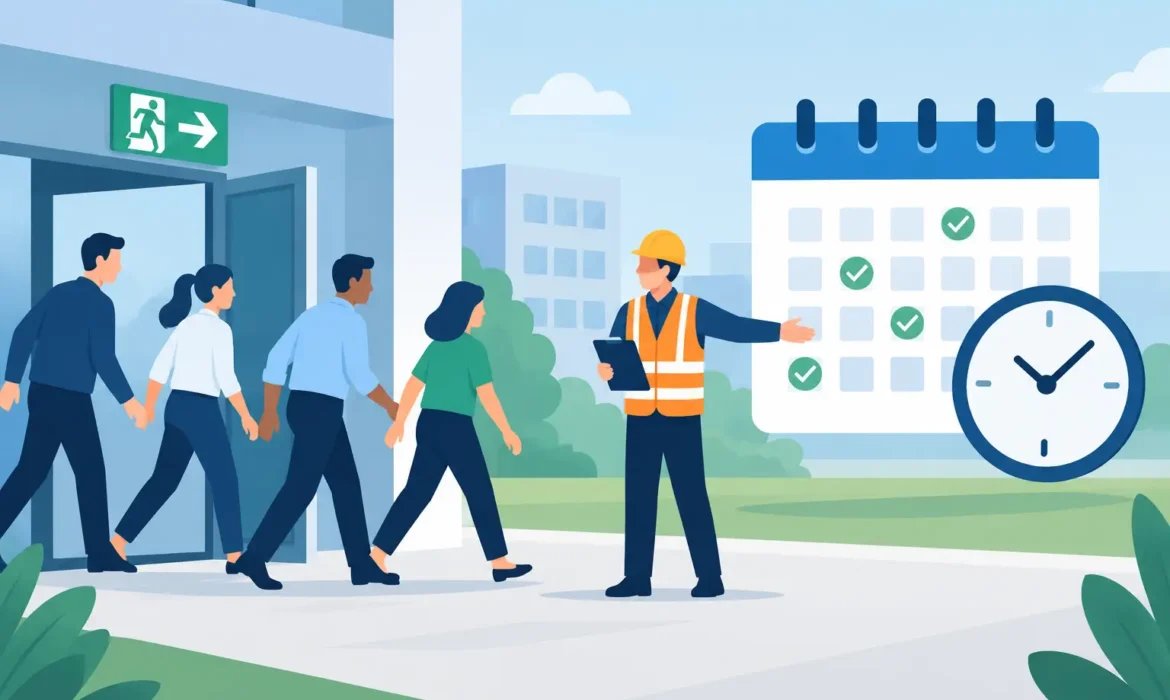
A fire alarm sounds during a live construction activity, a plant maintenance shutdown, or a busy office day. The real test is not whether an emergency plan exists in a file. It is whether people recognize the alarm, know where to go, understand who is in charge, and can account for every person quickly. Getting safety drill frequency right gives employers a reliable way to test that readiness before an actual emergency exposes gaps.
For Singapore employers managing mixed workforces, contractors, visitors, and rotating shifts, a calendar-only approach is rarely enough. A drill program should meet applicable legal, building, client, and insurer requirements, but it should also reflect the hazards, workforce changes, and operating conditions at each location.
Why Safety Drill Frequency Should Be Risk-Based
There is no single schedule that suits every workplace. A corporate office with stable occupancy and low physical risk needs a different drill program from a construction site, warehouse, marine operation, manufacturing facility, or chemical maintenance project. The more quickly conditions can change, the less value there is in relying solely on an annual routine.
Emergency drills are operational tests. They show whether escape routes remain clear, assembly areas are suitable, alarm signals are heard in noisy zones, wardens are available, and supervisors can account for outsourced personnel and subcontractors. They also show whether the emergency response plan still matches the work actually taking place.
A useful starting point is to assess the level of exposure. Consider the type of emergency reasonably foreseeable at the site, such as fire, chemical release, gas leak, confined-space rescue, medical emergency, severe weather, security incident, or loss of critical utilities. Then consider workforce factors: headcount, shift work, language needs, new hires, temporary workers, visitors, and the number of contractors working under separate supervisors.
Higher-risk operations generally need more frequent and more focused practice. This does not always mean running a full evacuation drill every month. It can mean combining planned full-scale drills with shorter scenario-based exercises, supervisor briefings, tabletop discussions, or team-level response checks. The aim is consistent competence, not unnecessary disruption.
How Often Should Workplaces Run Safety Drills?
Employers should first confirm the requirements that apply to their premises, industry, contracts, and emergency systems. Local regulations, fire safety conditions, landlord rules, client specifications, and internal management-system standards may each set minimum expectations. Those requirements are the floor, not automatically the best operating standard for every site.
For many lower-risk offices and commercial workplaces, a full evacuation drill at least once a year may provide a reasonable baseline when supported by induction training, warden refreshers, and updates after significant changes. Yet even an office can require more frequent practice if it has high occupancy, multiple tenants, vulnerable occupants, complex evacuation routes, or a history of poor drill performance.
Construction, industrial maintenance, logistics, manufacturing, and energy-related workplaces typically benefit from a more regular cycle. These environments may have changing work fronts, temporary access routes, hot work, lifting operations, hazardous substances, mobile equipment, and a large contractor population. A quarterly review or practical exercise is often more meaningful than waiting a full year to identify an outdated muster point or an unavailable fire warden.
Specialized emergency scenarios should follow the risk profile. A confined-space rescue arrangement cannot be verified by a standard building evacuation. Likewise, a facility handling chemicals or operating pumps, motors, hydraulic systems, or high-energy equipment may need targeted spill, isolation, rescue, and communication exercises. The right frequency depends on the hazard severity, the likelihood of exposure, the complexity of the response, and how often trained responders change.
New projects and major site changes should trigger an earlier drill or exercise. Do not wait for the usual date if a renovation alters exit paths, a shutdown brings in hundreds of temporary workers, a new shift starts, or a facility changes its emergency assembly area. A short validation exercise before work begins can be more cost-effective than managing confusion during a real event.
A Practical Drill Cycle
A dependable program usually has several layers. New employees and contractors receive emergency orientation before starting work. Designated wardens, first aiders, and response personnel receive role-specific training and periodic refreshers. The broader workforce takes part in scheduled practical drills, while management tests command, communications, and business continuity through more complex scenarios.
Varying the conditions matters. If every drill occurs on a quiet weekday morning, the organization only proves it can respond under ideal conditions. Rotate drills across shifts where feasible. Test an alternative exit route. Include a blocked access scenario, a missing-person report, or a communications failure. Keep the exercise proportionate to the workplace, but make it realistic enough to reveal decisions people would face under pressure.
What to Measure After Each Drill
A drill is not complete when people return to work. The debrief is where safety drill frequency becomes a management tool rather than a compliance activity. Record what happened, compare it with the emergency plan, assign corrective actions, and verify that those actions are closed before the next exercise.
Time to evacuate is useful, but it is not the only measure. An unusually fast evacuation may conceal unsafe behavior, such as workers running, bypassing supervisors, or leaving a colleague behind. Stronger indicators include whether alarms were recognized across all areas, whether wardens swept assigned zones, whether headcounts were accurate, and whether emergency services access remained unobstructed.
Review whether communication worked for everyone on site. In workplaces with multilingual crews, instructions may need to be reinforced through visual signage, supervisor briefings, or translated materials. For outsourced or temporary personnel, clarify who reports headcount information and who has authority to stop work and direct evacuation. Accountability often fails at the handover points between employers, subcontractors, and facility management.
Document practical observations as clearly as possible. For example, “two workers did not hear the alarm in the loading area” is actionable. “Drill needs improvement” is not. The corrective action may involve alarm audibility testing, additional visual beacons, relocation of a work station, or a revised notification process. The next drill should confirm whether the solution worked.
Common Mistakes That Weaken Emergency Readiness
The most common mistake is treating drills as a calendar obligation. When teams know the date, scenario, route, and expected outcome in advance, the exercise can become a rehearsal for passing an audit rather than responding to an emergency. Advance planning is necessary, but the operational details should not be so predictable that the result loses value.
Another mistake is applying one procedure to every hazard. Evacuating for a fire may be correct, while a chemical release, external security threat, or gas leak could require sheltering, isolation, or a controlled response. Plans must make these distinctions clear, and drill scenarios should test them where relevant.
Employers also underestimate workforce turnover. A well-designed drill from six months ago may no longer demonstrate readiness if the project team, security provider, subcontractor roster, or emergency wardens have changed. Staffing movements should be part of the trigger for reviewing drill frequency.
Finally, avoid running exercises without fixing findings. Repeated observations about unclear roles, inaccessible equipment, or inaccurate headcounts indicate a system weakness. Management should allocate owners, due dates, and resources to corrective actions, then review the results with site leadership.
Building a Schedule That Supports Operations
The best program balances preparedness with productivity. Excessive drills can disrupt critical production, tenant operations, patient care, or time-sensitive project work. Too few drills can leave a workforce unprepared and create far greater disruption after an incident. A bespoke schedule should therefore be built around real exposure, not copied from another site.
Start with the mandatory requirements, then map the hazards, workforce profile, emergency roles, and planned operational changes over the next 12 months. Schedule full drills when they will provide the clearest test, and add focused exercises where risk or turnover justifies them. Keep records consistent across sites so leaders can identify recurring issues and direct resources where they are needed.
For employers managing specialist manpower across multiple locations, coordination is particularly important. Supervisors must know which personnel are assigned to which muster point, who carries the current attendance list, and how visitors and mobile workers are accounted for. Safety consultants and workforce partners can help align inductions, emergency documentation, role assignments, and drill observations with the realities of project deployment.
ProSkill Workforce supports employers with emergency response planning, risk assessments, safety documentation, toolbox briefings, and practical workplace safety support tailored to site conditions. The objective is dependable readiness that protects people while helping projects and facilities remain compliant and productive.
A drill should leave the organization better prepared than it was an hour earlier. When frequency is based on risk, change, and verified performance, each exercise becomes a practical investment in people, continuity, and reliable operations.