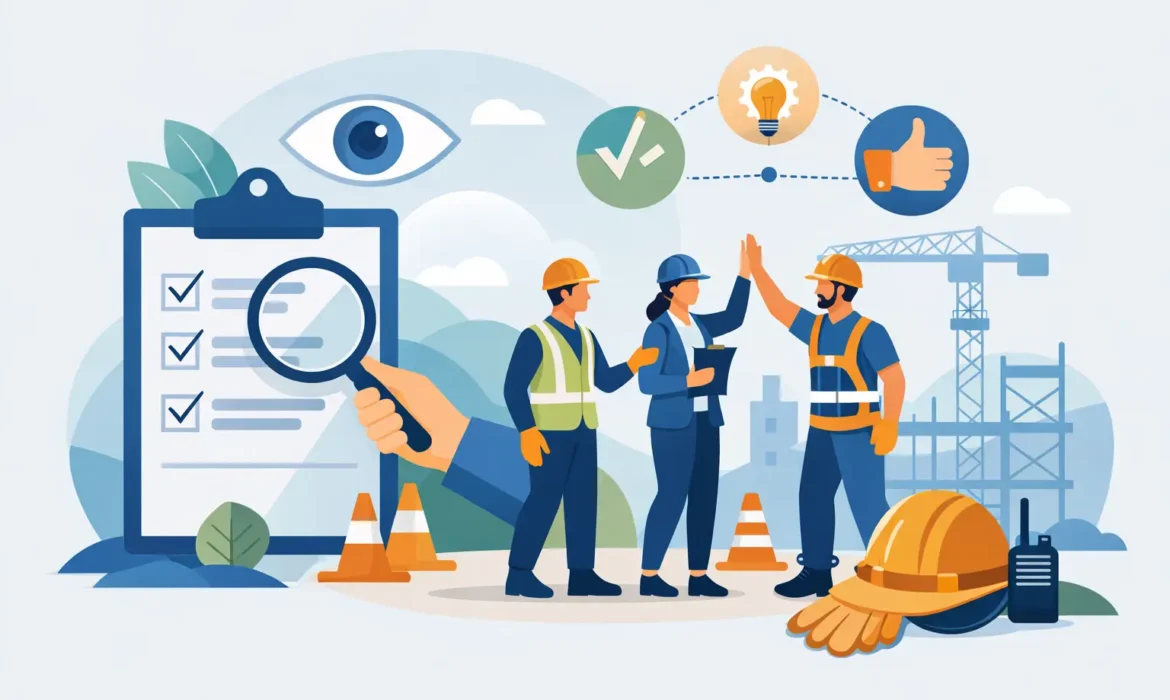
A worker pauses before climbing a ladder, checks the footing, and asks for a spotter. Another sees the same issue but continues because the task is behind schedule. Both situations can happen on a well-managed site. A behavior based safety program helps employers understand why safe choices are made, why they are missed, and what conditions must change to make safe work the normal way of working.
For construction, engineering, manufacturing, logistics, facilities, and plant maintenance teams, this is not a substitute for risk controls, training, or legal compliance. It is a practical layer of daily observation and constructive coaching that helps those controls work in the field.
What a Behavior Based Safety Program Is Designed to Do
A behavior based safety program is a structured process for observing work, discussing critical safe and at-risk behaviors, recording trends, and improving conditions before an incident occurs. It focuses on what people do during real tasks, such as using fall protection correctly, isolating energy sources, following lifting plans, wearing appropriate personal protective equipment, or maintaining safe access routes.
The strongest programs do not treat workers as the problem. They recognize that behavior is shaped by the environment: production pressure, unclear instructions, poor equipment availability, inadequate supervision, difficult work sequencing, and site conditions all affect decisions. If several workers bypass a control, the useful question is not simply, “Why did they break the rule?” It is, “What made the correct method difficult, slow, unclear, or impractical?”
That distinction matters. A blame-focused observation system encourages people to hide problems. A learning-focused system gives managers early warning of weak controls and helps crews participate in safer solutions.
Why Observation Alone Is Not Enough
Many companies begin with observation cards or checklists. These can be useful, but a stack of completed forms does not create a safer workplace. The value comes from the quality of the conversation, the follow-up on recurring findings, and visible action by leaders.
For example, repeated observations of workers carrying materials through an obstructed walkway may initially look like a housekeeping issue. A closer review may show that designated storage is too far from the workface, delivery timing is unplanned, or waste removal cannot keep pace with the project. Asking workers to “be more careful” will not solve those operational gaps.
A dependable program connects behavior observations to risk assessment, toolbox briefings, inspections, incident investigations, and supervisor planning. It should also distinguish between a one-off unsafe choice and a system issue that requires engineering, procurement, scheduling, or manpower support.
Start With the Work That Carries the Greatest Risk
An effective program does not attempt to observe every behavior on every shift. It begins with activities that have the highest potential for serious injury, major property damage, or operational disruption. On a construction site, that may include work at height, lifting operations, mobile plant movement, excavation, hot work, and temporary electrical installations. In facilities or industrial maintenance, critical areas may include lockout and tagout, confined spaces, chemical handling, rotating equipment, and shutdown work.
The observation checklist should be short, task-specific, and easy for supervisors and trained peer observers to use. It should identify the few behaviors that matter most, along with the conditions that support them. For lifting work, for instance, an observer may look at exclusion zones, communication between the rigger and operator, load stability, and whether the approved lifting plan matches the work actually being performed.
Generic checklists tend to produce generic findings. Bespoke checklists are more useful because they reflect the site, trade, equipment, workforce mix, and current project phase.
Involve the Workforce Before Setting the Checklist
Workers, team leaders, and subcontractors often know where procedures fail in practice. Their input can reveal common shortcuts, tools that are unavailable when needed, confusing permit requirements, or tasks that create conflicting priorities.
Involving the workforce does not mean allowing teams to negotiate away essential controls. It means using field knowledge to make controls workable. This also improves ownership. People are more likely to accept observations when they can see that the process reflects the realities of their work.
Train Observers to Coach, Not Police
The observer’s approach determines whether the program earns trust. An observation should begin respectfully, preferably during a natural pause in work unless there is an immediate danger requiring intervention. The observer should first recognize what is being done correctly, ask open questions about the task, and discuss any exposure without assumptions.
A useful conversation might sound like this: “I noticed the barricade is in place and the team is communicating well. Can you show me how you are keeping pedestrians out of the loading area?” If an issue appears, the next question is practical: “What would make it easier to maintain this control for the rest of the shift?”
Observers need clear boundaries. They must stop work where there is imminent danger, escalate serious control failures, and avoid using observations as a disciplinary quota. Personal accountability still matters, particularly for willful disregard of critical safety requirements. However, routine observations should not become a surveillance tool. If workers believe every conversation could lead to punishment, reporting quality will decline.
Turn Findings Into Corrective Action
Data should show leaders where to act, not merely how many observations were completed. Review findings weekly or monthly to identify repeated at-risk behaviors, positive safe behaviors, common locations, job types, and underlying conditions. Look for patterns across shifts, contractors, departments, and project stages.
The best reporting separates behavior from cause. “Worker did not wear gloves” is incomplete. A more useful finding might be: “Cut-resistant gloves were removed during fine assembly because the issued size reduced dexterity; alternative glove sizing was not available at the work area.” The first statement identifies a violation. The second provides a corrective path.
Actions should have an owner, due date, and verification method. Some fixes can happen immediately, such as replacing damaged signage or supplying additional PPE. Others may need project-level coordination, such as revising delivery routes, changing work sequencing, improving lighting, or adjusting manpower allocation. Workers should hear what changed because of their observations. This closes the feedback loop and shows that participation has value.
Measure Quality, Not Just Activity
Observation totals can indicate whether the program is active, but high numbers do not automatically mean high quality. A team may submit many cards while repeatedly recording minor housekeeping issues and missing critical exposures.
Balance activity measures with indicators that reflect learning and improvement. These may include the percentage of observations involving high-risk work, the number of recurring conditions resolved, close-out time for corrective actions, participation across contractors and shifts, and positive behaviors reinforced through coaching. Incident and near-miss trends can provide context, though they should not be the only measure of success.
It also helps to audit the program itself. Review whether observers are having meaningful conversations, whether checklists remain relevant, and whether management responses are timely. If crews see that issues remain open for months, confidence in the process will fade regardless of how polished the reporting dashboard appears.
Fit the Program Into Existing Safety Management
A behavior-based approach works best when it supports, rather than duplicates, established safety processes. Risk assessments identify hazards and controls. Method statements explain safe work methods. Toolbox briefings prepare crews for the day’s activities. Inspections verify workplace conditions. Behavior observations reveal whether controls are understood, available, and consistently applied under real operating pressure.
This integration is especially valuable for employers managing outsourced manpower, multiple subcontractors, or fast-changing work fronts. New personnel may be technically qualified yet unfamiliar with a client’s site rules, communication practices, and safety culture. Early observations provide a practical way to reinforce expectations and identify gaps before they become routine.
For complex projects, an external safety consultancy can provide independent program design, observer training, trend analysis, and audits while site leaders retain ownership of daily safety performance. ProSkill Workforce can support this work through customized WSH consulting that aligns behavior observation with workforce deployment, site documentation, and operational requirements.
Common Mistakes That Undermine Results
The most common mistake is launching a program with ambitious targets but no time for supervisors to coach and follow up. Another is focusing solely on unsafe acts while ignoring poor planning, equipment defects, and conflicting production demands. Programs also struggle when leadership only reviews negative findings and fails to recognize the safe behaviors that protect people every day.
Language and workforce diversity require attention as well. Instructions, observation forms, and coaching must be understood by the people performing the work. On multilingual sites, clear visuals, practical demonstrations, and supervisors who can communicate effectively are often more valuable than lengthy written procedures.
Finally, do not promise that behavior observation will eliminate all incidents. Safety performance depends on competent people, sound design, adequate resources, effective supervision, and disciplined risk control. The program is most valuable because it helps an organization see weak signals early, while there is still time to correct them.
A well-run behavior based safety program gives leaders a clearer view of how work is truly performed, not just how it is written in a procedure. When workers are listened to, supervisors are equipped to coach, and corrective actions are completed reliably, safer behavior becomes a practical part of getting the job done right.