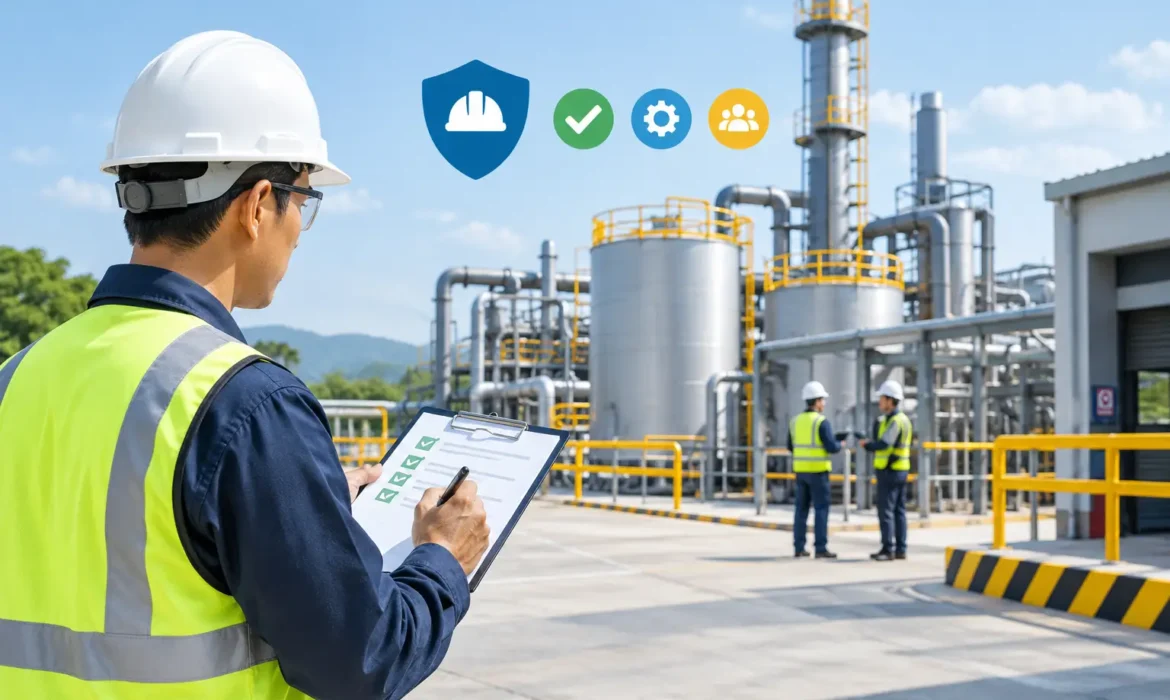
A missing guard, an obstructed exit, or an expired lifting certificate can turn a routine shift into an avoidable incident. A disciplined safety inspection and audit process gives employers a clear view of conditions before they affect people, schedules, equipment, or project margins. For construction sites, factories, warehouses, commercial facilities, and maintenance operations, the objective is not simply to pass a review. It is to maintain reliable control over how work is actually performed.
Safety Inspection and Audit: Know the Difference
Inspections and audits support the same outcome, but they answer different questions. Treating them as interchangeable often leaves gaps in a company’s workplace safety and health program.
A safety inspection is a direct examination of the workplace, task, equipment, or behavior at a point in time. A site supervisor may inspect scaffolding before work begins, check that fire extinguishers are accessible, verify that electrical cables are protected, or observe whether workers are using the required personal protective equipment. Inspections are practical, frequent, and focused on identifying immediate hazards and corrective actions.
A safety audit takes a wider view. It assesses whether the safety management system is designed effectively, implemented consistently, and supported by evidence. The auditor may review risk assessments, training records, permit-to-work controls, incident trends, contractor management, emergency arrangements, inspection reports, and close-out records. The question is not only whether a guardrail is in place today, but whether the organization has a dependable process to identify, correct, and prevent similar risks across its operations.
Both are necessary. Inspections protect the worksite in the moment. Audits test whether the systems behind those inspections can be trusted over time.
Why Routine Checks Fail to Prevent Repeat Issues
Many employers conduct regular checks yet continue to see the same findings: poor housekeeping, incomplete documentation, unauthorized work at height, untagged equipment, or weak control of subcontractors. The issue is usually not a lack of forms. It is a lack of follow-through.
A checklist can record that a hazard exists, but it cannot establish who owns the correction, what resources are required, or whether the action was verified. When inspection findings are closed without evidence, minor defects remain in circulation until site conditions change or an incident occurs.
There is also a practical trade-off between frequency and quality. Daily supervisor checks may be short and focused because crews need to start work. A monthly inspection can examine broader trends, while a periodic independent audit can challenge assumptions that internal teams no longer notice. The right schedule depends on the nature of the work, its risk level, workforce turnover, and how quickly site conditions change.
For example, a stable office environment may rely on scheduled facilities inspections and emergency preparedness reviews. A plant shutdown, renovation project, confined-space activity, or heavy lifting operation requires more frequent, task-specific verification. High-risk work cannot wait for the next monthly meeting.
Build a Safety Inspection Process That Works on Site
An effective inspection program begins with clear scope. Generic forms may be useful as a starting point, but they should be customized for the site and activity. A warehouse needs controls for vehicle-pedestrian separation, racking condition, loading bays, battery charging, and manual handling. A construction site may need stronger focus on work at height, lifting operations, temporary electrical systems, excavation, access routes, and contractor coordination.
The inspection should be completed by a person who understands the work and has authority to raise concerns. Supervisors are essential because they see daily conditions, but they should not be the only reviewers. Safety personnel, engineers, maintenance leads, facilities managers, and trained worker representatives can provide different perspectives and reduce the risk of routine checks becoming a box-ticking exercise.
Each finding needs enough detail for someone else to act on it. “Poor housekeeping” is rarely sufficient. A useful record identifies the exact area, the unsafe condition, the potential consequence, the required action, the responsible person, and the target completion date. Photographs can support clarity where appropriate, particularly for equipment defects, blocked access, damaged flooring, or inadequate edge protection.
Priority matters. Not every observation requires the same response. A blocked emergency exit, damaged lifting sling, exposed live wiring, or missing fall protection may require immediate work stoppage and isolation. Lower-risk issues can be scheduled for correction, but they should still be tracked until verified. Delaying urgent action because a report has not been finalized is poor operational control.
What a Meaningful Safety Audit Should Examine
A safety audit should follow a defined standard, company policy, legal requirement, or client expectation. It should be evidence-based rather than dependent on assurances from managers or contractors. Auditors need to review documents, speak with workers, observe actual work, and compare stated procedures with what happens on the ground.
A thorough audit commonly examines whether the organization has:
- Current risk assessments that reflect the work being performed
- Defined roles, competent persons, and adequate supervision
- Training, toolbox briefings, and records that match workforce needs
- Effective controls for permits, equipment maintenance, and high-risk activities
- Incident reporting, investigation, and corrective-action processes
- Emergency response arrangements tested through drills or exercises
- Contractor and subcontractor controls that apply consistently across the site
The strongest audits also look for patterns. If workers repeatedly receive the same briefing but cannot explain the key controls, the problem may be training quality rather than attendance. If defects recur after close-out, the issue may be weak maintenance planning, insufficient spare parts, unclear accountability, or production pressure overriding safe work practices.
An audit should not become a search for fault. Its value is in identifying system weaknesses early enough to improve them. Teams are more likely to report concerns honestly when they know the process will lead to practical support, not automatic blame.
Turn Findings Into Measurable Improvement
The period after an inspection or audit is where compliance discipline is proven. Findings should enter a corrective-action register with a named owner, due date, risk rating, and verification method. Senior managers need visibility over overdue high-risk actions, especially where corrective work requires budget approval, shutdown planning, engineering changes, or coordination with multiple contractors.
Closing an action should mean more than marking a spreadsheet complete. Verification may involve a follow-up inspection, a photograph, a test certificate, a revised procedure, or a discussion with the affected workers. For significant findings, assess whether similar conditions exist elsewhere. A damaged access ladder at one location may indicate that the broader inspection and replacement process needs attention.
Useful performance measures balance activity with outcomes. Counting completed inspections is helpful, but it does not show whether the program is improving safety. Employers should also monitor overdue actions, repeat findings, time taken to close high-risk issues, near-miss reporting quality, training effectiveness, and trends by department, contractor, or work activity.
Numbers require context. A rise in reported near misses can indicate worsening conditions, but it can also show that workers have greater confidence in reporting. Leaders should investigate the story behind the data before drawing conclusions or setting targets that discourage honest reporting.
Make Contractors Part of the Control System
In multi-employer workplaces, safety performance depends on more than the main employer’s procedures. Contractors, temporary workers, and specialist vendors must understand site rules, task hazards, reporting lines, and emergency arrangements before they begin work.
Prequalification helps, but certificates and past experience are only one part of the assessment. Site-specific induction, supervision, coordination meetings, and field verification remain necessary. A contractor may have an acceptable safety policy yet struggle with the actual controls required for a complex renovation, shutdown, lifting operation, or occupied commercial facility.
This is where workforce planning and safety planning should meet. When skilled personnel are deployed quickly without adequate role clarity, orientation, or competent supervision, operational risk rises. Employers benefit from a partner that understands both manpower requirements and safety obligations, particularly where projects require specialized trades, safety professionals, or short-term technical support.
Create a Culture That Supports Early Intervention
Workers are often the first to notice a change in conditions: a machine vibration, a damaged cable, a rushed lifting plan, or a delivery route becoming unsafe. Their observations should reach the people who can act on them without unnecessary delay.
Leaders set the standard through visible behavior. When supervisors stop unsafe work, address concerns respectfully, and explain why controls matter, employees are more likely to speak up. When production deadlines consistently override stated rules, even well-written procedures lose credibility.
ProSkill Workforce supports employers that need bespoke safety consultancy and capable workforce solutions across regulated and operationally demanding sectors. The most cost-effective approach is not simply adding more inspections. It is building a dependable process where the right people, controls, documentation, and corrective actions work together.
A safety inspection and audit program earns its value when a worker can identify a concern in the morning and see a clear, verified response before that concern becomes the next incident.