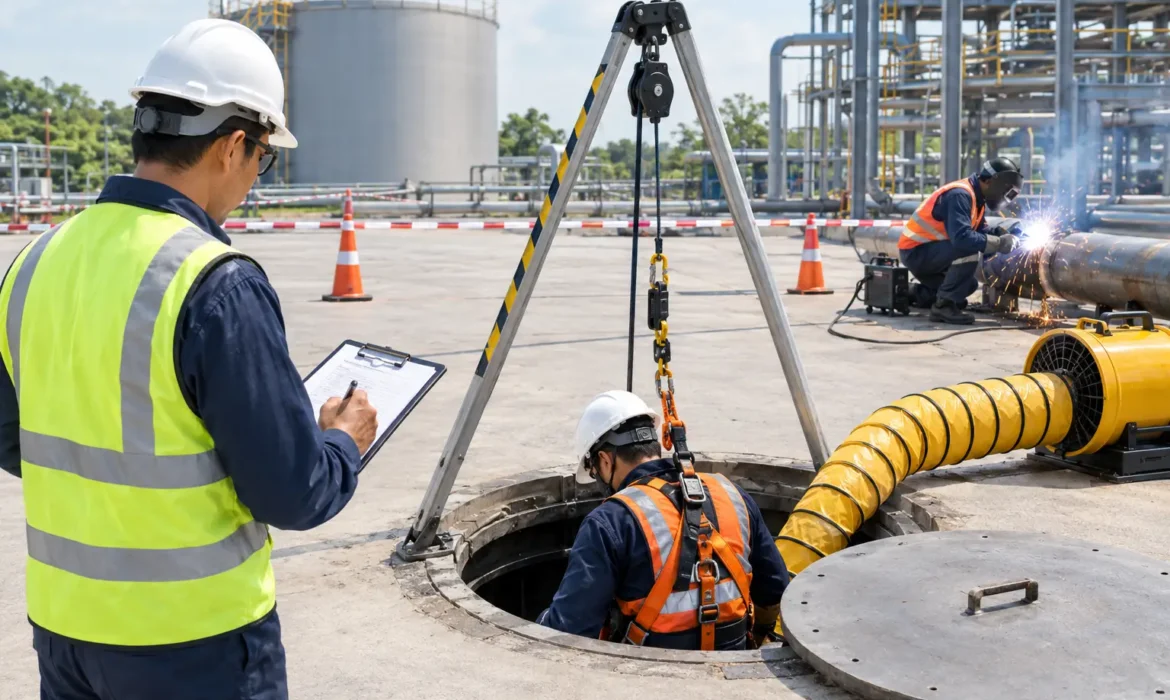
A tank entry delayed by one missing isolation, or hot work started beside an unprotected flammable source, can stop an entire project and place people at serious risk. A safety assessor (confined space and hot-work assessor) provides the competent, site-focused oversight needed to prevent these failures before work begins. For Singapore employers, this role is not simply a permit-signing function. It is a practical control point for protecting workers, meeting workplace safety obligations, and keeping high-risk operations on schedule.
What a Safety Assessor Does on Site
Confined-space and hot-work activities often sit within the same maintenance shutdown, construction package, or facility repair scope. A vessel may need welding after cleaning. A pipe rack may require cutting near process equipment. A basement utility chamber may need inspection, repair, or cable installation. Each activity has its own hazards, but the risks can compound when work is poorly sequenced or inadequately controlled.
The assessor reviews the actual work environment before authorization is granted. That means checking whether the proposed controls match the conditions on site, not merely whether a form has been completed. The role commonly involves verifying risk assessments, work method statements, permit-to-work documentation, isolation arrangements, atmospheric testing records, access and egress, fire precautions, rescue arrangements, and communication between work teams.
For confined spaces, the assessor must be satisfied that entry conditions are safe and that workers can be recovered quickly if conditions change. For hot work, the focus includes ignition sources, combustible materials, gas cylinders, fire watch coverage, firefighting equipment, and the condition of surrounding areas. The assessor should also consider how nearby operations, changing weather, shift handovers, or simultaneous activities may affect the permit conditions.
A competent assessor does not create unnecessary delay. Instead, the assessor identifies gaps early enough for the project team to correct them without turning a manageable issue into a work stoppage or incident.
Why Confined Space and Hot Work Need Separate Attention
Confined-space work can expose personnel to oxygen deficiency, toxic gases, flammable atmospheres, engulfment, heat stress, restricted movement, and difficult rescue conditions. A space that appears safe at the point of entry can become hazardous when ventilation fails, residues are disturbed, or another contractor starts work nearby.
Hot work brings a different set of immediate threats. Welding, cutting, grinding, brazing, and other spark- or flame-producing activities can ignite vapors, dust, coatings, insulation, debris, or materials hidden behind walls and within voids. Fires are not always immediate. Smoldering materials can develop into a serious event after workers have left the area.
The trade-off is clear: production teams may want permits issued quickly, particularly during shutdowns or compressed project schedules. However, speed without verification transfers risk to workers, supervisors, and the business. A reliable safety assessor helps teams move efficiently by clarifying exactly what must be corrected, who is responsible, and when the work can proceed.
What Employers Should Expect From a Safety Assessor
The right assessor combines technical knowledge with practical authority. They should be comfortable reviewing documentation, walking an active site, questioning assumptions, and communicating directly with project managers, supervisors, contractors, and workers.
For confined-space work, employers should expect clear verification of entry permits, atmospheric monitoring, ventilation, lockout or isolation controls, stand-by personnel, communication methods, and emergency rescue readiness. Rescue planning deserves particular attention. Calling emergency services may be part of the response, but it is not a substitute for a workable on-site recovery plan when the first minutes matter.
For hot work, an assessor should confirm that the permit scope is specific to the task and location. General statements such as “welding at site” are not enough. The review should account for combustible materials, shielding, spark containment, fire extinguishers, fire watch arrangements, nearby openings, and post-work monitoring. If the work area changes, the permit conditions may need to be reassessed.
Employers should also expect sound judgment around stop-work decisions. A dependable assessor knows the difference between a minor housekeeping issue that can be corrected immediately and a serious control failure that requires the job to pause. This balance protects safety without imposing unnecessary disruption on the operation.
Selecting a Safety Assessor for Confined Space and Hot Work
Qualifications matter, but certificates alone do not establish competence for a specific workplace. The assessor should have relevant training and authorization for the duties required, as well as experience in the work environment. A facility maintenance project, a marine repair job, a construction site, and an oil and gas shutdown may all involve confined spaces or hot work, yet their hazards and operating controls differ substantially.
When evaluating an assessor, look beyond a resume. Consider whether the person can interpret your site risk assessments, understand the sequence of work, and work effectively with your permit issuer, entry supervisor, fire watch, safety coordinator, and contractor teams. Strong communication is especially valuable where workforces include multiple languages, subcontractors, or rotating shifts.
Availability is another operational consideration. High-risk work often occurs outside ordinary office hours, during weekends, or within tight shutdown windows. A staffing plan should define who will cover permit verification, reassessment, shift handover, and emergency escalation throughout the full duration of the work. Assigning one person on paper without adequate coverage can create a weak point during the most critical period.
Building Permit Controls That Work in Practice
Permit-to-work systems are most effective when they reflect how work is actually managed. Overly complex documents can lead to rushed checkboxes. Overly general permits can leave workers uncertain about boundaries and responsibilities. The goal is a controlled process that supervisors and workers can understand, apply, and verify in the field.
A well-run process starts before the permit is issued. The team should confirm the job scope, identify interfaces with other activities, isolate energy and process hazards, establish emergency arrangements, and brief everyone involved. The assessor then provides an independent and competent check that the controls are ready for use.
Conditions must also be monitored after authorization. For example, a confined-space atmosphere may change due to nearby chemical cleaning, welding fumes, reduced ventilation, or a change in the material being handled. A hot-work area may become unsafe if combustible packaging accumulates, temporary barriers are removed, or another crew opens a line nearby. Revalidation and clear handover procedures are essential when conditions, personnel, or shifts change.
The strongest sites treat these checks as part of delivery discipline rather than as a compliance burden. When supervisors know that permit controls are consistent and assessors are responsive, they can plan labor, equipment, and work sequencing with greater confidence.
When Outsourced Assessor Support Makes Business Sense
Not every employer needs a full-time confined-space and hot-work assessor. Project workloads fluctuate. A plant shutdown may require several competent personnel for a short period, while routine maintenance may only require support on selected days. Recruiting internally for every peak can increase fixed costs and leave the business under-resourced when urgent work arises.
Outsourced assessor support can provide a cost-effective alternative when it is carefully matched to the site and scope. It is particularly useful for shutdowns, renovations, turnaround work, emergency repairs, contractor-heavy projects, and temporary increases in permit activity. The key is not merely filling a headcount. The provider should understand the industry, validate competency, and align the assessor with the client’s permit system, site rules, work culture, and operating schedule.
ProSkill Workforce supports employers with bespoke manpower and workplace safety consultancy solutions for high-risk operations, helping teams access reliable professionals while maintaining the compliance discipline required for safe project delivery.
Better Assessment Supports Better Project Outcomes
A capable assessor protects more than compliance records. Their work can reduce rework, prevent avoidable permit delays, improve contractor accountability, and give project leaders clearer visibility over high-risk activities. That value is most visible when the assessor is involved early, before crews, equipment, and schedules are committed to an unsafe plan.
For employers managing confined-space entry and hot work, the practical question is not whether assessment is necessary. It is whether the person performing it has the competence, authority, and site awareness to make the controls meaningful. Get that decision right, and safer work becomes a dependable part of project performance rather than a last-minute obstacle.