A project manager wins a fit-out contract and mobilizes a crew. Two weeks in, the client’s safety team asks who the appointed WSH person is. The answer needs to be immediate and it needs to be right.
Appointing a coordinator where the law expects a registered officer isn’t a paperwork problem. It’s a compliance gap, and it surfaces during an inspection, a bizSAFE audit, or a client prequalification review.
The confusion is understandable. Job ads use the titles loosely. The qualifications overlap on paper. And the requirements shift depending on what kind of workplace you run and how large the contract is. This guide sets out what each appointment actually is, how Singapore employers work out which one applies, and what to check before you put someone’s name on a form.
The three WSH appointments Singapore employers deal with
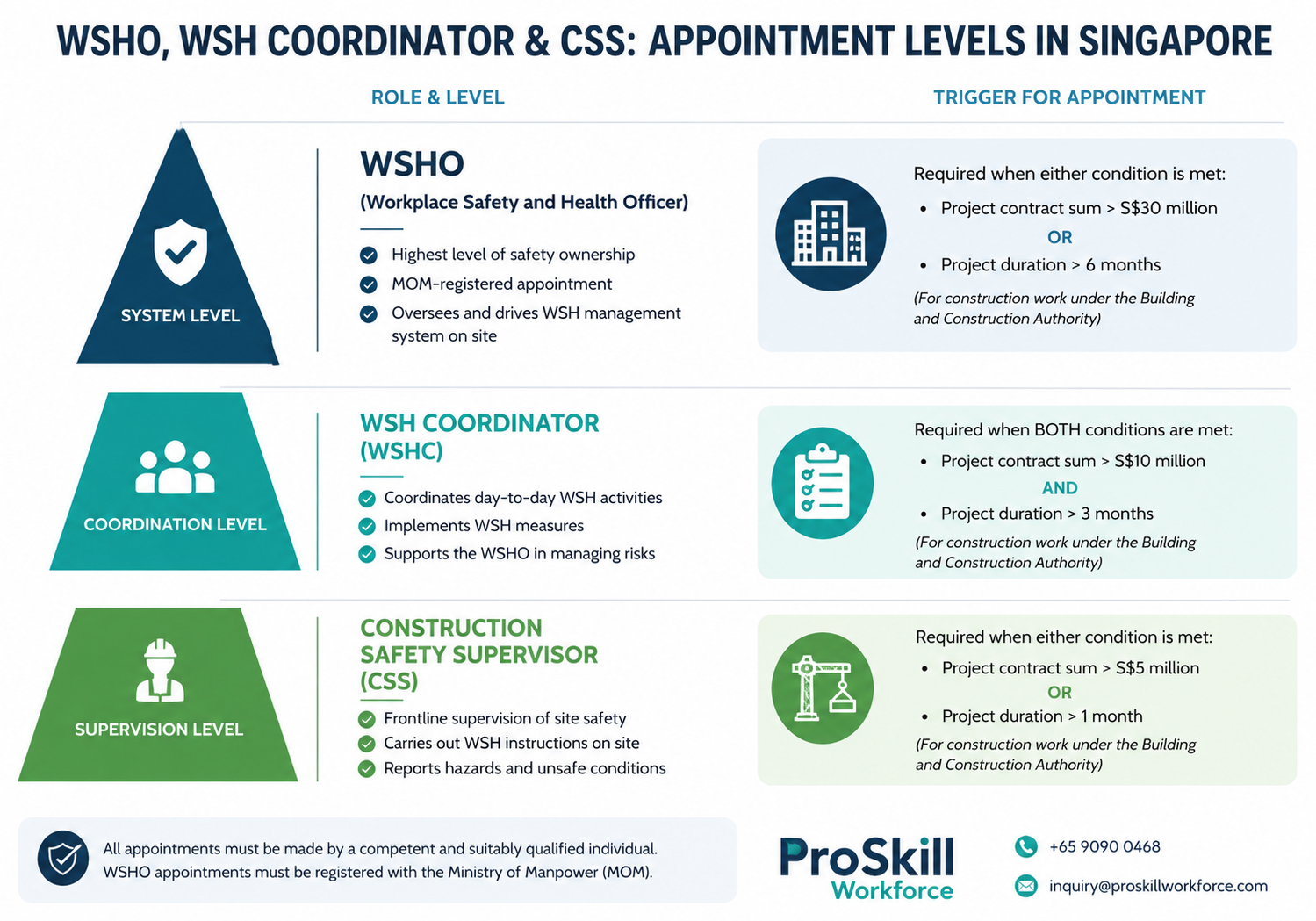
Singapore’s framework is tiered. Each tier has a different scope, a different qualification route, and a different trigger.
Workplace Safety and Health Officer (WSHO)
A WSHO is a competent person registered with the Ministry of Manpower under the Workplace Safety and Health (Workplace Safety and Health Officers) Regulations. Registration is the defining feature. You cannot hand someone the title internally and be done with it.
The role is advisory and systemic. A WSHO advises the occupier on safety matters, runs internal audits and risk assessments, investigates incidents, and acts as the organization’s point of contact with MOM. That last function matters more than employers expect. When an inspector arrives, the WSHO is the person who has to explain the site’s controls and produce the records.
The scope covers the whole safety management system, not individual tasks. So a WSHO needs a working knowledge of the system end to end, plus enough standing to raise issues with management. Employers who need that coverage without a permanent headcount usually look at a part-time WSHO arrangement or engage a WSHO service provider.
Workplace Safety and Health Coordinator (WSHC)
A WSHC supports the coordination and implementation of safety activity at a worksite. The safety coordinator roles and responsibilities are operational: toolbox meetings, site inspections, helping implement the safe work procedures and risk management plan someone else has already developed, and acting as the link between workers, supervisors and the safety team.
The coordinator route is typically associated with smaller construction projects that fall below the contract-sum threshold requiring a registered WSHO. Our page on WSH coordinator services in Singapore sets out how the role is usually scoped and deployed.
Construction Safety Supervisor (CSS)
A CSS is the operational supervisor layer on construction worksites. This is the person watching the work as it happens. Not the person designing the system that governs it.
On a live site the CSS, the coordinator and the officer aren’t alternatives to each other. They sit at different distances from the work face.
How to work out which appointment applies to you
Three variables usually decide it: your sector, your headcount, your contract value.
Shipyards, marine engineering operations, petroleum and petrochemical facilities and bulk chemical manufacturing sit in higher-risk categories, where a registered officer is expected however small the operation feels. General manufacturing and factory workplaces cross the threshold on headcount. Construction projects cross it on contract sum.
Below those thresholds no statutory WSH Officer is required, which is not the same thing as no safety accountability. A competent point of contact is still expected, and bizSAFE Level 3 effectively assumes one exists. Offices and professional-services workplaces land in this space more often than not.
If you’re genuinely unsure where your workplace sits, establish your risk profile through a documented risk assessment first, then map that against the regulations. Our guide to WSH risk assessment services covers what that process involves. Copying a competitor’s org chart is how employers end up under-appointed.
One more thing that catches construction employers. MOM appointments aren’t the only ones your project may trigger. Sites above a certain contract sum must also appoint an Environmental Control Officer registered with NEA, under completely separate legislation. Satisfying your WSH obligations does nothing for that requirement.
Why Singapore SMEs get caught out most often
The national picture is hard to ignore. In his opening address at the bizSAFE Convention, MOM noted that SME employees accounted for about seven in ten fatal and major injuries in 2022, at a time when SMEs employed roughly 70% of Singapore’s workforce. The exposure is proportionate to their share of employment. The resourcing rarely is. MOM has acknowledged that building a strong WSH culture is harder for SMEs given constraints on manpower, time and budget.
That resourcing gap is where appointments quietly fail. A small contractor names a competent person, the person leaves, nobody re-appoints. A factory grows past a headcount threshold and nobody revisits the requirement. A project scope expands mid-contract and the original appointment no longer fits the work.
None of these look like problems until something triggers a review.
What non-compliance actually costs
The penalties under the WSH Act are worth reading plainly, because they get misquoted a lot.
For offences where no penalty is expressly provided, MOM sets general penalties at a maximum fine of S$500,000 for a corporate body on first conviction, rising to S$1 million for repeat offenders. For individuals, which includes directors and senior managers, the maximum is S$200,000, up to two years’ imprisonment, or both. That rises to S$400,000 for repeat offenders. No imprisonment term attaches to a corporate body.
Separately, from 1 June 2024, maximum fines for breaches of WSH Act Subsidiary Legislation that could potentially result in death, serious bodily injury or a dangerous occurrence went from S$20,000 to S$50,000. Composition fines doubled to a minimum of S$2,000 per lapse from 14 June 2022. Failing to comply with a Stop Work Order carries a maximum fine of S$500,000, plus another S$20,000 for each day the offence continues.
Full details sit on MOM’s WSH Act liabilities and penalties page.
In-house, part-time or outsourced?
Once you know which appointment you need, the next question is how to resource it.
A permanent in-house hire makes sense when the role is central to continuing operations, when the site is complex enough to need daily presence, or when you want safety knowledge to accumulate internally over years instead of resetting with every project.
Outsourced and part-time arrangements fit a different shape of need. A defined project phase. A site that has just crossed a threshold. A gap left by a resignation. An organization that needs specialist coverage without carrying a senior salary through quiet periods. Both routes are covered on our safety officer outsourcing page.
The trade-off is real and worth naming. Outsourcing buys you continuity of coverage and an independent view. It also puts much more weight on how well the arrangement is defined: site access, authority to raise and escalate issues, reporting lines, and what happens when the assigned person is unavailable. An external officer with no standing to stop unsafe work is not much use to anyone.
Continuity is often what decides it. Internal staff take leave, change roles and resign. Where an appointment is a statutory requirement, a gap in coverage is a gap in compliance, not just a staffing inconvenience.
What to check before you appoint anyone
Before a name goes on a form, work through six things.
Verify registration status directly with MOM for a WSHO role, instead of accepting a certificate at face value. Check sector relevance, because a shipyard, a cleanroom, a logistics hub and a commercial fit-out present very different risks and sector experience shortens the ramp-up considerably. Confirm scope match — has this person actually held the level of responsibility you’re asking for, or only supported someone who did?
Then the three that get skipped. Put authority in writing: what the appointee can halt, who they escalate to, how corrective actions get tracked to closure. Ask about coverage continuity during leave, illness or resignation, and get the answer before you need it. And settle documentation ownership — who maintains inspection records, risk assessments, incident reports and audit evidence.
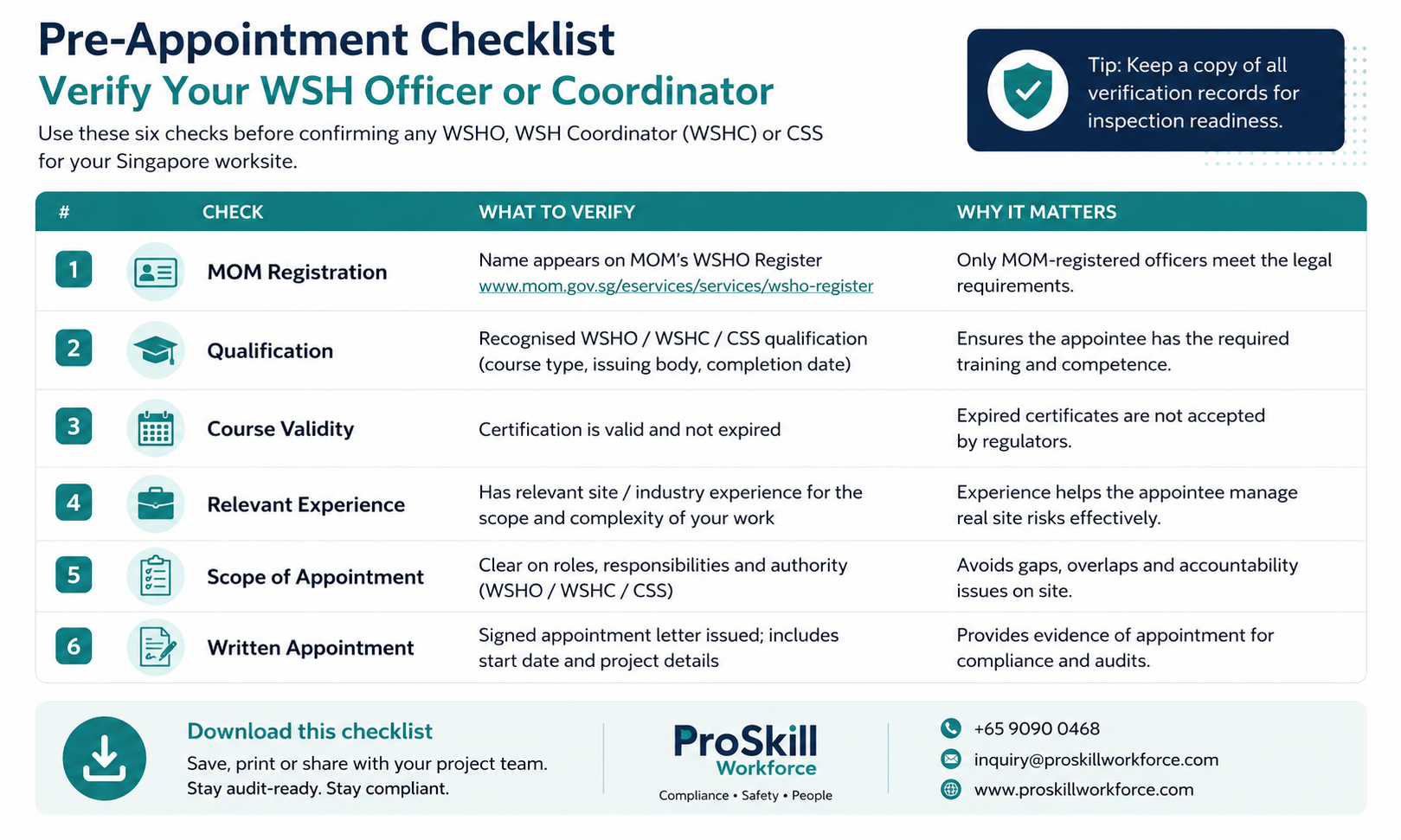
Six checks to complete before appointing a WSH Officer, WSH Coordinator or Construction Safety Supervisor in Singapore.
Frequently asked questions
Does a small office in Singapore need a registered WSH Officer? Usually not. Most professional-services and corporate office environments fall below MOM’s thresholds. A competent safety point of contact is still expected, and bizSAFE Level 3 certification assumes one is in place.
Can one person hold the WSHO appointment for several sites at once? Depends on the sites. Higher-value construction projects are expected to have dedicated resident coverage. Multi-site arrangements generally require approval and get assessed case by case, so check with MOM instead of assuming.
Is an outsourced WSHO acceptable to MOM? Outsourced and part-time arrangements are used across Singapore. Acceptability depends on your workplace classification and whether all the statutory duties are genuinely being discharged: risk management, inspections, incident investigation, records. A named appointment with no real presence doesn’t satisfy the requirement.
What is the difference between a WSHO and a WSHC? A WSHO is registered with MOM and carries system-level responsibility for the safety management system. A WSHC supports day-to-day implementation at site level, and is typically associated with projects below the WSHO contract-sum threshold. They’re not interchangeable.
How often does bizSAFE Level 3 need renewing? MOM states that bizSAFE Level 3 renewal happens every three years. More than half of all construction companies in Singapore hold at least bizSAFE Level 3. Our bizSAFE Level 3 guide walks through the full pathway.
What happens if our appointed officer resigns mid-project? The requirement doesn’t pause. You need replacement coverage in place, and you should expect to explain any gap if an inspection or audit falls in that window. This is easily the most common reason employers move to an outsourced or backed-up arrangement.
Getting the appointment right the first time
Employers who handle this well decide the appointment during project planning, not after mobilization. They establish the requirement before the contract is signed, resource it deliberately, and give the appointee enough authority to be useful.
ProSkill Workforce Pte Ltd places MOM-registered Workplace Safety and Health Officers and supporting WSH personnel across construction, marine, manufacturing, logistics and facilities operations in Singapore, alongside WSH consultancy covering risk assessments, safety audits and incident investigation.
Related reading: Workplace safety consultancy in Singapore · Does your site need an Environmental Control Officer? · Fire Safety Manager services · Work at height: plans, permits and who needs what
If you’re not certain which appointment your worksite requires, tell us the sector, the headcount and the contract scope. We’ll tell you what the requirement looks like and what it would take to cover properly. Call +65 9090 0468 or email inquiry@proskillworkforce.com.