Reporting a Workplace Accident to MOM: What Counts, and the 10-Day Clock
If you’re reading this while a workplace accident is still open, here’s the short version. Report within 10 days. If you’re unsure whether the accident qualifies, MOM’s own guidance is to report it. Failing to report is an offence carrying a fine of up to S$10,000 for a first offence.
The longer version matters because the reportable threshold is lower than most employers assume, and several common scenarios that don’t look like workplace accidents are reportable.
What counts as a reportable workplace accident
Work-related accidents, dangerous occurrences and occupational diseases must all be reported to MOM. The requirements differ by type, and so does who carries the duty. Employer, workplace occupier or doctor, depending on the situation.
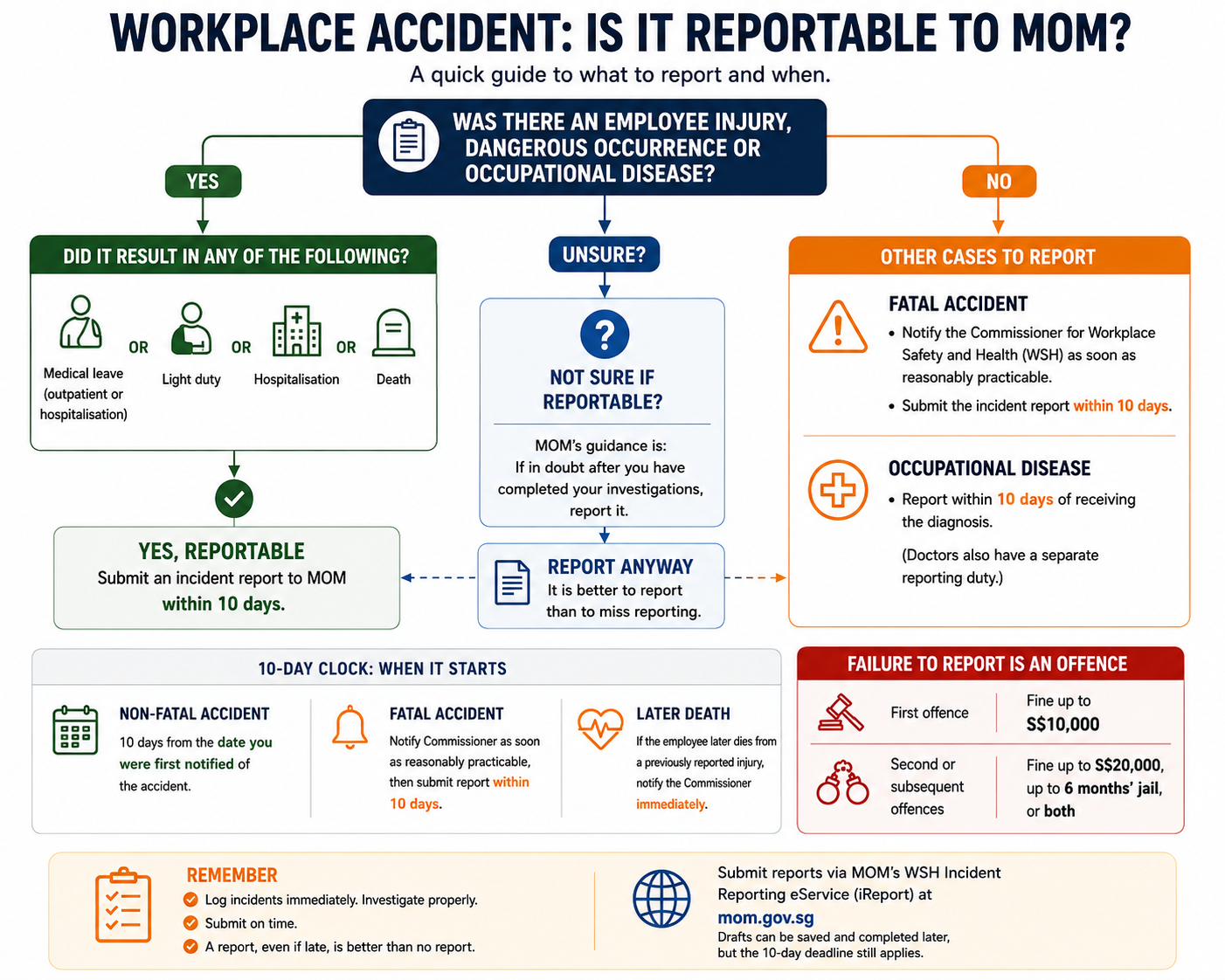
For a work injury, MOM’s guidance on what and when to report sets the trigger as an employee injured in a work accident, or who contracted a disease from work exposure to a biological or chemical agent, resulting in any of the following: outpatient or hospitalisation leave, light duty, or death.
That threshold is worth reading twice. Light duty alone makes an accident reportable. So does any instance of medical leave. MOM’s work injury claim guidance for employers states that an employee needs to be hospitalised or given any instance of medical leave or light duty for a non-fatal accident to be reportable.
This is where employers who learned the rules some years ago go wrong. An older framework was widely understood to require more than three consecutive days of medical leave before a report was due, and that understanding is still circulating in industry articles. Working from it today means under-reporting.
Scenarios employers routinely miss
MOM’s guidance and industry commentary converge on a few situations that don’t feel like reportable workplace accidents but are.
A medical condition suffered at the workplace counts. MOM’s examples include an employee suffering a heart attack or stroke at work, and the employer reports it. Work-related traffic accidents also fall within scope, whether the worker was travelling for work or on company transport. So do injuries during overseas assignments, for Singapore residents employed by a Singapore employer.
Incidents involving another employer’s workers on your premises are the ones that cause most confusion. MOM’s own example is a fire explosion at a construction worksite injuring two workers, where the duty falls on the employer of the injured workers, with the occupier notifying the Commissioner. On a multi-contractor site, the reporting duty may not sit with the party who first learns about the incident.
Occupational disease works on a slightly different clock. Where a doctor diagnoses one, an incident report goes in within 10 days of receiving the diagnosis, and medical practitioners have their own separate reporting duty.
When the clock starts
The deadline is 10 days. The start point differs by case type.
For non-fatal accidents, the 10 days run from the date you were first notified of the accident.
For fatal accidents, notify the Commissioner for Workplace Safety and Health as soon as reasonably practicable, then submit the incident report within 10 days.
If an employee later dies from an earlier reported injury, notify the Commissioner immediately.
The distinction between “date of accident” and “date you were first notified” matters on sites where an injury travels up the chain slowly. It also means an internal log capturing the date a supervisor first hears about an injury is worth keeping, because it establishes when your clock started.
What non-compliance costs
Per MOM, failing to report as an employer is an offence and you’ll be fined up to S$10,000 for the first time. For second or subsequent offences, the penalty is a fine of up to S$20,000, up to six months’ jail, or both.
There’s an important practical point here. If you’ve already missed the deadline, the obligation doesn’t lapse. You still must report, and the reporting system asks for the reason for late reporting. A late report is a materially better position than no report, because the offence attaches to the failure to report.
After the report
Submitting the report isn’t the end of the process.
MOM may investigate the accident. Separately, the law requires you to review and revise your risk assessment in light of the incident and brief workers on the revised controls. An incident that produces a report but no change to the workplace safety and health control measures on site leaves the same conditions in place. Our WSH risk assessment services page covers what that revision involves.
If the injured employee’s medical leave is extended after you file, the report needs updating. Employers and occupiers must also retain incident reports.
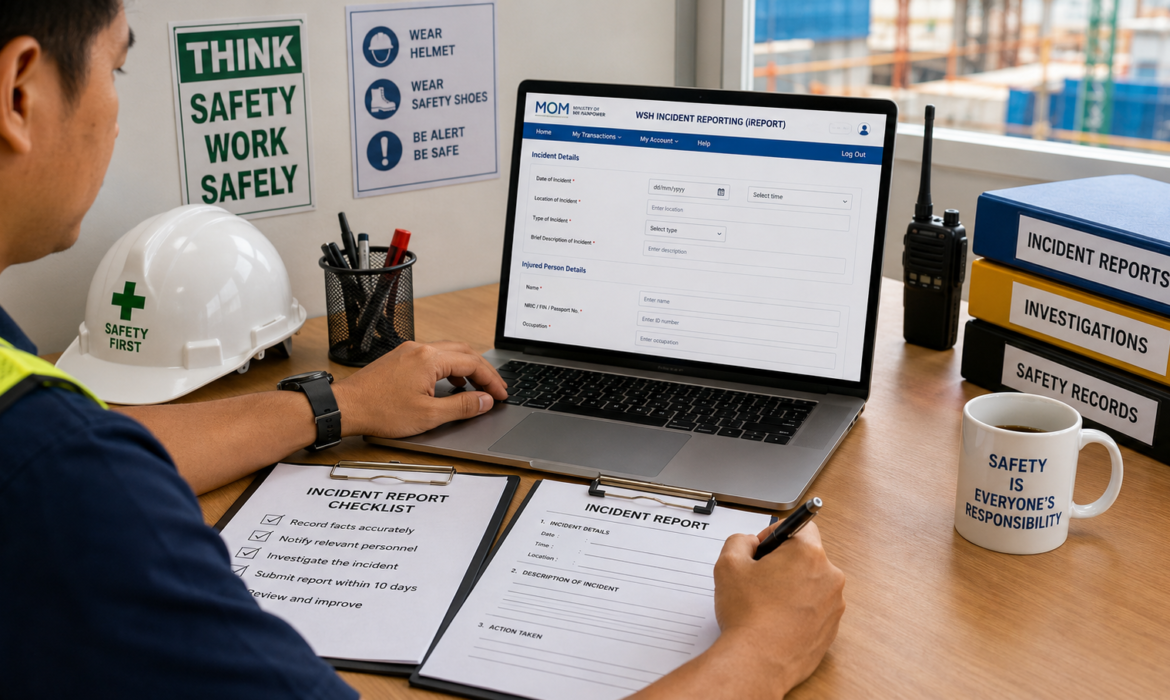
Reports go through MOM’s WSH Incident Reporting eService (iReport) on mom.gov.sg, alongside related eServices for amending submitted reports. Drafts can be saved and completed later, though the deadline runs regardless.
Build the process before you need it
Employers who handle incident reporting badly are rarely acting in bad faith. They’re learning the eService for the first time under time pressure, with an injured worker, an anxious client, and a supervisor who reported the injury four days late.
A few things prevent that. Log every instance of work-related medical leave or light duty the moment it happens, so the clock is never missed by accident. Make sure more than one person knows how to submit through iReport. And decide in advance who investigates, because a report filed without a proper investigation behind it tends to produce follow-up questions you can’t answer.
For sites where investigation capability is thin, resource this before an incident and not after. A structured workplace incident investigation establishes what happened and feeds the risk assessment revision the law requires, which is the part that actually reduces the chance of a repeat. Sites running regular toolbox briefings and a behavior-based safety program tend to surface near-misses earlier, and that’s the cheapest version of this problem to solve.
Frequently asked questions
How long do I have to report a workplace accident in Singapore? Ten days. For non-fatal accidents, from the date you were first notified. For fatal accidents, notify the Commissioner as soon as reasonably practicable and submit the report within 10 days.
Is an accident reportable if the worker only got light duty? Yes. Light duty alone makes a work accident reportable, as does any instance of medical leave.
What if I’m not sure whether an incident is reportable? MOM’s guidance is that if there’s doubt after you’ve completed your investigations, report it.
What happens if I miss the 10-day deadline? You must still report. The eService asks for the reason for late reporting. Failing to report at all is the offence, carrying a fine of up to S$10,000 for a first offence.
Is a heart attack at work reportable? MOM’s examples include an employee suffering a medical condition such as a heart attack or stroke at the workplace, with the employer reporting.
Who reports when a subcontractor’s worker is injured on my site? Generally the employer of the injured worker reports, with the occupier notifying the Commissioner. Confirm the specific allocation for your situation against MOM’s guidance, since it varies by incident type.
Do I need to do anything after submitting the report? Yes. Review and revise your risk assessment and brief workers on the new controls. Update the report if the worker’s medical leave is later extended.
Get the reporting duty owned by someone specific
Ten days is a short window when an incident has just happened and the people who would normally handle it are dealing with the aftermath. Organizations that meet it reliably have decided beforehand who logs, who investigates and who submits.
ProSkill Workforce Pte Ltd provides WSH consultancy including incident investigation, risk assessment and safety audits, and places registered WSH professionals with Singapore employers across construction, marine, manufacturing, logistics and facilities.
Related reading: WSH risk assessment services · Workplace safety and health officer services · Workplace safety consultancy in Singapore · Emergency response plans for Singapore workplaces
Call +65 9090 0468 or email inquiry@proskillworkforce.com.