If you manage a building that needs a Fire Certificate, your renewal paperwork just got lighter. Your inspection obligations did not.
From 1 April 2026, the Singapore Civil Defence Force extended FC validity from one year to three, for buildings that require a certificate and have a good compliance track record. Renewal applications and fee payments now happen once every three years instead of annually. For owners and managing agents who were running the same submission cycle every twelve months, that’s a real cut in administrative load.
The risk sits in what the change didn’t touch. You still need a Professional Engineer to inspect your fire safety systems every year, and you still need to submit an FC form certifying those systems are in good working condition. Read the headline and stop there, and the first gap won’t surface until an annual submission is already overdue.
Who needs a Fire Certificate in the first place
Under Section 35 of the Fire Safety Act 1993, the owner or occupier of a public building meeting the specified criteria must apply for and hold a Fire Certificate. The criteria sit on SCDF’s Fire Certificate page. Public buildings here include offices, hospitals, shopping complexes, industrial buildings and private residential buildings.
The main trigger is occupant load. A public building other than a residential building with an occupant load of more than 200 persons falls within scope. There are carve-outs for serviced apartments with external corridors and standalone carparks that comply with Chapter 2 of the Fire Code, and for hawker centres or wet markets not fully enclosed on all sides. Separate criteria catch industrial buildings, foreign dormitories, hospitals, taller residential buildings and engineered timber buildings, so read the full list rather than assuming the 200-person trigger is the only one.
For a new building, the initial application goes in within twelve months after obtaining the Certificate of Statutory Completion or Temporary Occupation Permit. The scheme exists to confirm that fire safety systems are being properly maintained and tested against the relevant codes of practice. It isn’t a check that they were installed correctly at handover. If you need help preparing or lodging the submission, we cover that on our Fire Certificate application assistance page.
What the three-year regime changed
Three things moved on 1 April 2026.
Certificates issued or renewed with a validity start date from 1 April 2026 onward now run for 36 months, unless otherwise stated.
Renewal applications, fee payment included, go in once every three years. The submission deadline itself didn’t move. Applications must reach SCDF at least two months before the existing certificate expires.
Revised fees apply from the same date and are payable once every three years. Per SCDF’s circular on the three-year FC regime, the application fees become S$11 per storey for residential buildings and S$36 per storey for non-residential buildings, against the previous $11 and $33 charged annually. SCDF puts the saving at roughly two-thirds a year for compliant owners.
One qualifier is easy to miss. SCDF extended the validity period for buildings that require an FC and which have a good compliance track record. It isn’t unconditional. If your FC expires or is revoked because of a late or incomplete submission, SCDF places the premises back on a one-year regime until consistent compliance is demonstrated.
What did not change: the annual PE inspection
This is the part worth repeating to whoever in your organization handles compliance dates.
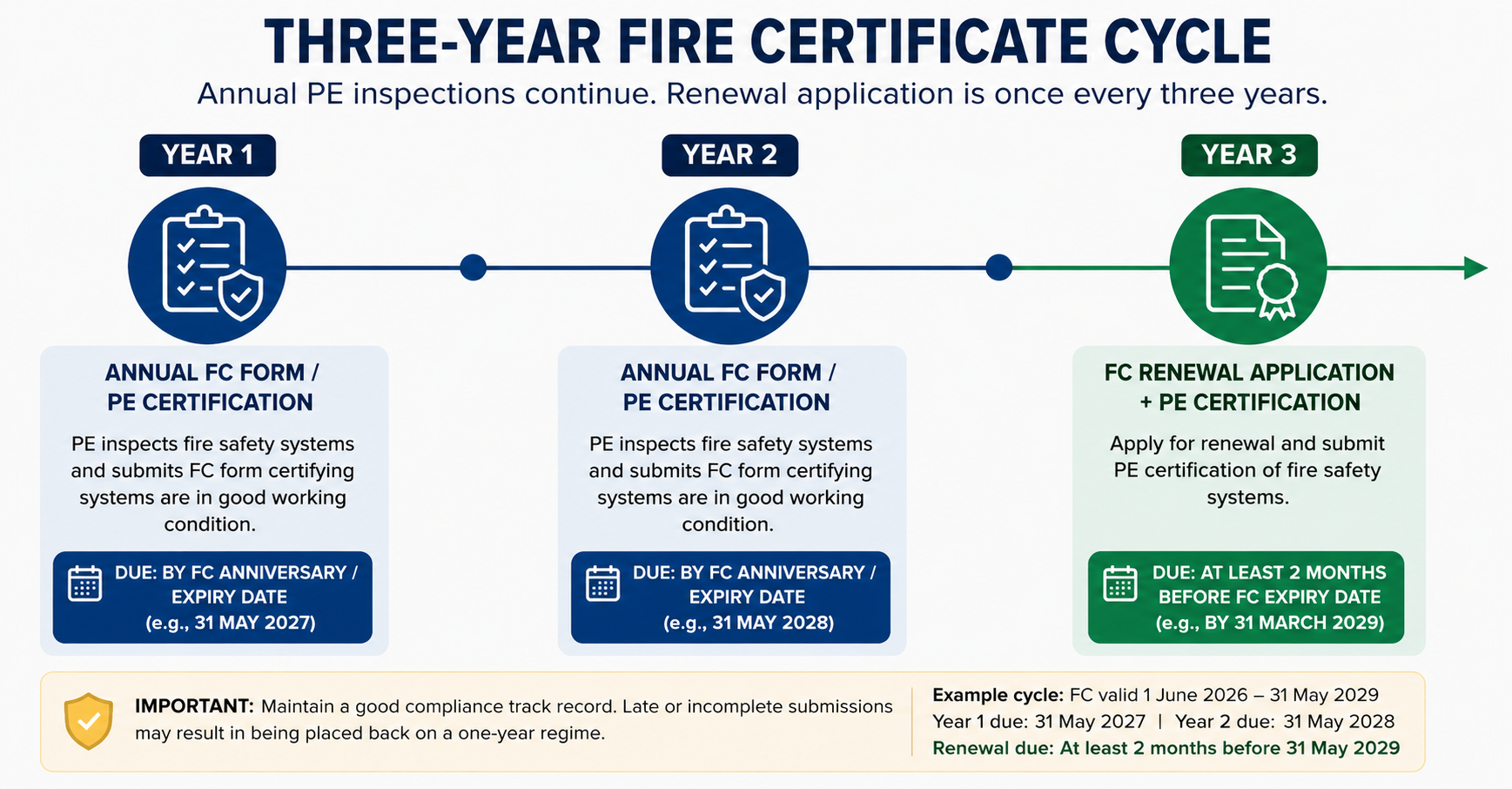
You must continue to engage a Professional Engineer, as necessary, to conduct annual inspections of the building’s fire safety systems and to submit the FC form certifying those systems are in good working condition. SCDF’s stated reason is straightforward. Mechanical and electrical systems deteriorate over time, so a three-year gap between physical checks would leave real risk unmanaged.
Here’s what a three-year cycle now looks like in practice. Say your certificate carries a 31 May expiry. You submit your first annual FC form by 31 May of year one. Second annual FC form by 31 May of year two. Then apply for renewal with PE certification at least two months before your 31 May expiry in year three. The cycle repeats.
Two of those three years involve a submission that isn’t a renewal. That’s precisely the kind of obligation that gets dropped when a building changes managing agents, when the person who held the calendar leaves, or when someone assumes a three-year certificate means a three-year gap in everything.
SCDF has said it will keep conducting random audits on PE inspections throughout the validity period, including in years when the FC isn’t due for renewal, and buildings must continue submitting PE inspection dates on request. If your inspection records are incomplete when that request arrives, the shortfall becomes visible immediately. Scheduled fire safety inspection support is the usual way owners keep that record continuous.
Two further points from SCDF’s FAQ are worth knowing before you rely on the lighter cycle. Missing an FC form deadline in a non-renewal year results in SCDF revoking the FC with immediate effect and initiating enforcement action, which can include fines and court prosecution. On the other side, SCDF has said it will send reminder notices four months ahead of each annual FC Form deadline, though it stresses that compliance remains the owner’s responsibility whether or not the reminder arrives.
Where building owners tend to get caught
A few failure patterns recur across Singapore premises.
Treating the certificate date as the only date. The renewal is now the least frequent event in the cycle. It’s the annual FC form submissions that will trip owners up between 2027 and 2029, and missing one costs you the certificate outright.
Leaving rectification too late. Applications must go in at least two months before expiry. If a PE inspection surfaces deviations, those need rectifying before the submission, not after. Working backward from the deadline, the inspection needs to happen well before the two-month mark, not against it.
Assuming an FSC covers you. A Fire Safety Certificate certifies that a building’s fire safety provisions comply with the Fire Code, and it’s typically issued once for a new or renovated building. A Fire Certificate covers the ongoing maintenance of fire safety measures in qualifying premises and gets renewed periodically. Some premises need both. Our page on FSM and FSC services explains where the two sit relative to each other.
Losing continuity at handover. When a managing agent changes or a facilities lead resigns, the inspection schedule, PE engagement, prior FC forms and any outstanding deviation records need to transfer cleanly. They often don’t.
Changing the use of a space without revisiting fire safety provisions. Converting a warehouse to F&B, or a retail unit to a childcare centre, changes the fire risk profile and may change what’s required of the premises.
Building a cycle that survives staff turnover
The administrative relief here is genuine. It only holds if the annual obligations are owned by someone specific.
Set the annual PE inspection as a fixed recurring commitment, not something triggered by an approaching certificate expiry. Book it early enough in the year that any rectification work has room to complete before the FC form is due. Keep the inspection reports, FC form submissions and maintenance records for fire protection systems in one place that survives a change of personnel, because SCDF may ask for the inspection schedule at any point. A fire safety audit checklist is a reasonable backbone for that record.
For premises that also fall under Workplace Safety and Health obligations, it helps to run fire safety alongside the rest of the compliance calendar instead of as a separate track. Emergency response planning, evacuation drills, and routine inspections of escape routes, fire doors and extinguishers all sit adjacent to the FC cycle, and the same people are usually involved in both. If you’re not certain which WSH appointments your premises requires alongside its fire obligations, our page on WSH coordinator services works through where the role sits.
Where a building requires a fire safety manager, that appointment is the natural home for this cycle. An FSM who runs the inspection schedule, tracks defects through to closure and holds the documentation gives you continuity that doesn’t depend on any one employee staying in the role. Whether the role is filled internally or through an outsourced FSM arrangement, the ownership question is the same.
Frequently asked questions
Does the three-year Fire Certificate mean I only inspect every three years? No. Annual Professional Engineer inspections remain mandatory, and an FC form certifying that systems are in good working condition must still be submitted each year. Only the renewal application and fee payment moved to a three-year cycle.
When must a renewal application be submitted? At least two months before the existing Fire Certificate expires. This requirement didn’t change under the new regime.
What does the Fire Certificate cost now? S$11 per storey for residential buildings and S$36 per storey for non-residential, payable once every three years rather than annually. Under the old regime the same storeys cost $11 and $33 every year.
How do I submit an FC application or renewal? Through the GoBusiness licensing portal, which requires Corppass for business users. SCDF publishes submission guidance on its Fire Certificate page.
What is the difference between a Fire Safety Certificate and a Fire Certificate? A Fire Safety Certificate certifies that a building’s fire safety provisions comply with the Fire Code, and it’s typically a one-time certification for new or renovated buildings. A Fire Certificate applies to qualifying premises and certifies that fire safety measures are being properly maintained on an ongoing basis. Some premises require both.
Do I need a Fire Safety Manager if my building holds a Fire Certificate? Not automatically. The FSM requirement is triggered separately by premises type and risk. Our guide to who needs a Fire Safety Manager in Singapore sets out the criteria.
What happens if SCDF selects my premises for audit? SCDF notifies the owner or occupier to submit their PE inspection schedule. Having current inspection records and closed-out deviations at that point is what makes the audit straightforward.
Plan the next two years, not just the next renewal
Buildings that handle this transition well will be the ones setting up their year-one and year-two submissions now, while the change is still recent enough to be front of mind. The ones that struggle will file the renewal, feel relieved, and look at the calendar again in 2029.
ProSkill Workforce Pte Ltd supports Singapore building owners and occupiers with Fire Certificate compliance, Fire Safety Manager placement, fire safety inspections and emergency response planning, alongside broader WSH consultancy for premises managing both fire and workplace safety obligations.
Related reading: Fire Safety Manager services in Singapore · Workplace safety and health officer services · Emergency response plans that work under pressure · Workplace safety consultancy
If you’re not sure where your building sits in the new cycle, send us your certificate expiry date and building type. We’ll map out what’s due and when. Call +65 9090 0468 or email inquiry@proskillworkforce.com.