Work at Heights in Singapore: Fall Prevention Plans, Permits, and Who Needs What
Falls from height have been one of Singapore’s most persistent causes of workplace death, and the WSH Council’s guidance on preventing falls still describes them as contributing to more than a third of total workplace fatalities each year.
The recent numbers are better than that. MOM’s Workplace Safety and Health Report 2025 records 36 workplace fatal injuries, with vehicular incidents, falls from height, and collapse or failure of structures and equipment together accounting for 78% of them. Fatal falls from height hit a ten-year low of four in 2024.
That improvement is real, and it doesn’t change the regulatory position. Injuries from falls are typically more severe than other accident types, which is why the regulations governing this one activity remain unusually detailed — and why an inspector’s questions don’t get easier as the statistics improve.
The detail is where employers get caught. Most site teams know a harness is required. Fewer can say precisely when a Fall Prevention Plan becomes mandatory, at what point work becomes hazardous work at height requiring a permit, or who is legally allowed to issue that permit. Those are the questions an inspector asks, and they determine whether your paperwork holds up.
The regulations that govern work at height
Work at height in Singapore is governed by the Workplace Safety and Health (Work at Heights) Regulations 2013, made under the WSH Act. The regulations place duties on employers, self-employed persons and principals to implement control measures that prevent falls or reduce the consequences when they occur.
The structure of the regulations tells you what matters. Separate provisions deal with covers, guard-rails and barriers, travel restraint systems, fall arrest systems, inspection, staircases, safe access and egress between working levels, teagle openings, work on roofs, fragile surfaces and ladders. An entire Part is devoted to the permit-to-work system for hazardous work at height, and a further Part covers industrial rope access systems.
Alongside these, the WSH (Risk Management) Regulations require a risk assessment for work activities. Work at height included.
The Fall Prevention Plan
A Fall Prevention Plan is a site-specific plan to eliminate or reduce the risk of falls. It isn’t a generic corporate document reused across projects. The whole point is that it reflects the actual site. Anyone searching for a fall prevention plan template Singapore should treat what they find as a starting structure and not a compliance artifact.
As an occupier of a worksite, shipyard, or premises for bulk storage of toxic or flammable liquid, you’re required to implement an FPP where work at height is carried out. The requirement reaches further than most employers assume. Per the WSH Council, it also applies to factories that manufacture or process petroleum, petrochemicals and their products, factories manufacturing chlorine, fluorine, hydrogen fluoride or carbon monoxide, and any factory employing 50 or more people. A mid-sized manufacturer with no construction work at all can sit inside this.
A meaningful FPP identifies the hazards, the control measures, the anchorage and equipment to be used, the rescue arrangements, and the competent persons responsible. Rescue is the element most often treated as an afterthought. A fall arrest system that stops a worker mid-air without a plan to retrieve them has solved half the problem, which is why fall rescue belongs inside your emergency response plan and not beside it.
The plan should be implemented in accordance with any Approved Code of Practice issued by the WSH Council.
The hierarchy of controls, in the order that matters
Singapore’s framework expects controls applied in order of effectiveness, not convenience.
Eliminate the work at height where reasonably practicable, through design changes, ground-level assembly or remote methods. Where it can’t be eliminated, install passive fall prevention: permanent guard-rails, safety mesh, covers over openings. These protect everyone in the area without depending on individual behavior.
Below that sit travel restraint systems, which stop a worker reaching an unguarded edge in the first place, and then fall arrest systems, which act only after a fall has begun.
Administrative controls — procedures, briefings, signage — come last.
The practical implication is that reaching for a harness first is the wrong instinct. A harness is a late-stage control. If it’s the only control in place, the assessment behind it was probably incomplete.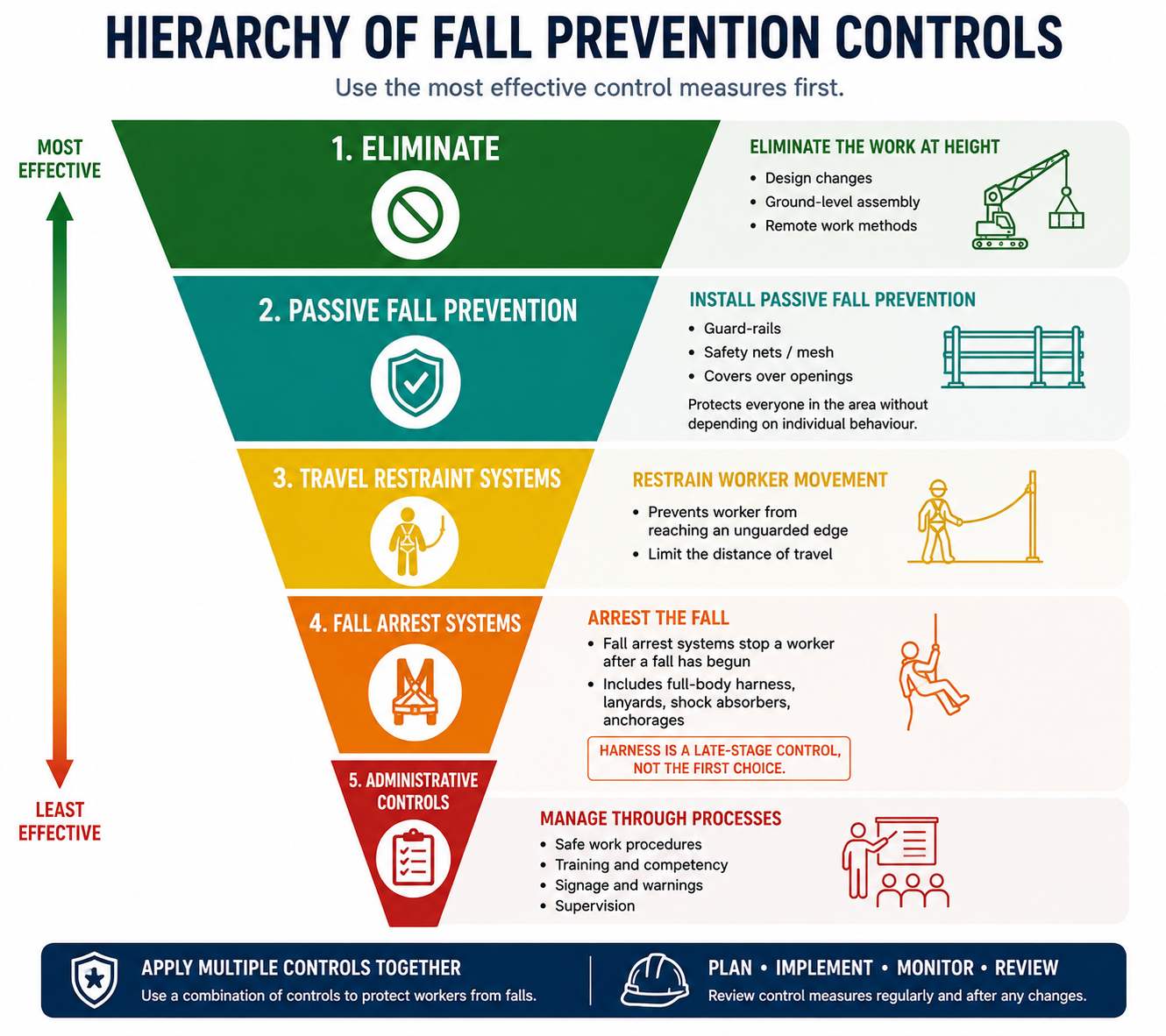
When work becomes “hazardous” and needs a permit
This is the threshold that generates the most confusion on Singapore sites.
A permit-to-work system is a documented process required for hazardous work at height, defined by a combination of the height a person could fall and the type of workplace. The height triggering the permit requirement is distinct from the general definition of work at height. Two different thresholds are in play: one for whether the activity is regulated at all, one for whether a permit is required. Confirm both against the regulations for your workplace type.
The regulations set out the permit process in sequence. Application for a permit, evaluation of the application, issue of the permit, posting of the permit and the supervisor’s duty, monitoring of the work, a duty to report incompatible work, and daily review and revocation. Two provisions deserve emphasis.
Daily review comes first. A permit isn’t a document you raise once and leave pinned to a board for the duration. The regulations provide for daily review and revocation, which means the permit reflects today’s conditions and today’s authorized workers.
Then incompatible work. There’s a specific duty to report it. Hot work directly below a work-at-height activity, or a lifting operation crossing the same zone, creates risk that neither activity’s own permit captures. Someone has to be looking across permits, not just within them.
Competency is individual and expires
Workers performing work at height must hold current WAH competency certification from a MOM-approved training provider, and this applies to every individual regardless of employment status. A subcontractor’s worker, an agency worker and a directly employed worker are all subject to the same requirement, and the host site carries responsibility for ensuring the people on it are trained and equipped. Employers bringing in crews through a construction manpower supply arrangement should confirm certification currency at mobilization instead of assuming the supplier tracked it.
Certification also lapses. The practical control is a training matrix showing who is certified, when each certificate expires and when refreshers are scheduled.
The failure mode here is mundane. A long project runs past a certificate expiry, nobody is tracking it, and a worker who was properly certified at mobilization isn’t certified at the time of the incident.
Where site teams commonly fall short
Five patterns account for most of it.
A generic Fall Prevention Plan, first. If the FPP doesn’t name the actual anchorage points and the actual rescue arrangement for this site, it’s documentation and not control.
Permits raised but not monitored, second. The regulations impose duties around posting the permit, supervision and monitoring the work. A permit in a folder with nobody watching the activity satisfies none of them.
Third, nobody checking across concurrent activities. The duty to report incompatible work exists precisely because parallel operations create hazards that individual permits miss.
Fourth, ladders treated as outside the system. The regulations address ladders specifically. Short-duration work on a ladder is still work at height.
Fifth, certification tracked only at mobilization. See above. This is the most avoidable gap on long projects.
Getting this right is largely a question of whether someone competent owns the system day to day. On sites where a registered WSH Officer or WSH coordinator holds the fall prevention plan, the permits and the training matrix together, these gaps tend not to open. Where responsibility is split across people who each assume someone else is tracking it, they do.
Frequently asked questions
Does every work-at-height activity need a permit-to-work? No. A permit is required for hazardous work at height, which is a narrower category defined by height and workplace type. Lower-risk work at height still requires a Fall Prevention Plan, risk assessment and appropriate controls.
Is a Fall Prevention Plan the same as a risk assessment? No. The risk assessment is required under the WSH (Risk Management) Regulations across work activities generally. The Fall Prevention Plan is a site-specific plan addressing fall risk in particular. Related, but not interchangeable.
Who can issue a permit-to-work? The regulations set out an application, evaluation and issue process involving designated roles, with an authorized person evaluating and issuing. Confirm the specific competency requirements for each role against the regulations before assigning them.
Do subcontractors’ workers need their own WAH certification? Yes. Competency certification is individual. Every person performing work at height needs valid certification regardless of who employs them, and the site is responsible for ensuring this.
Does work on a flat roof require a permit? Not necessarily. There are situations where a permit may not be required, such as a flat roof with a perimeter parapet wall of sufficient height and no openings or open sides. Confirm the specific exemptions against the regulations instead of relying on a general description.
How long is a permit valid? The regulations provide for daily review and revocation, so permits are managed on a short cycle and not issued open-ended for the duration of a task.
Make one person accountable for the system
Work at height compliance in Singapore isn’t difficult to understand. It’s difficult to sustain, because it depends on documents staying current, permits being reviewed daily and certifications being tracked over months. Those are ownership problems more than knowledge problems.
ProSkill Workforce Pte Ltd places WSH professionals including registered WSH Officers and safety supervisors across construction, marine, manufacturing and facilities projects in Singapore, and provides WSH consultancy covering risk assessment, safe work procedures and safety audits.
Related reading: Workplace safety and health officer services · WSH risk assessment services · Workplace safety consultancy in Singapore
Tell us the site type, the work scope and the project duration, and we’ll set out what coverage the work at height component needs. Call +65 9090 0468 or email inquiry@proskillworkforce.com.