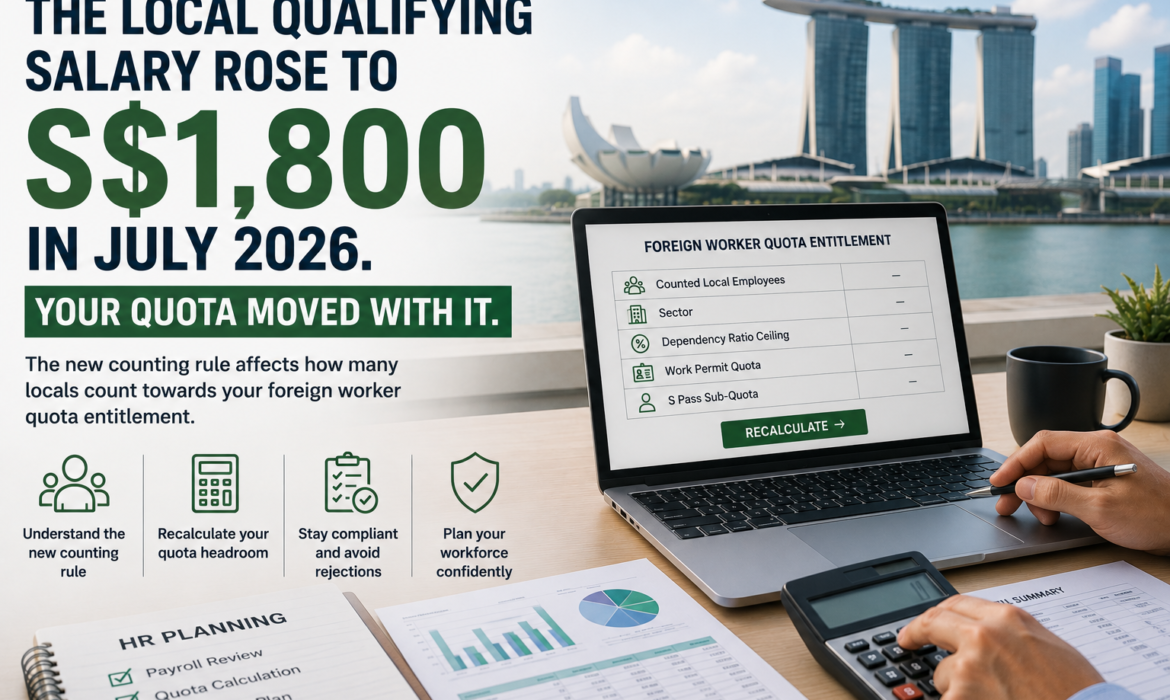
The Local Qualifying Salary Rose to S$1,800 in July 2026. Your Quota Moved With It.
[IMAGE — Hero, 1200×630 | Photo or clean editorial graphic: a payroll/HR screen or spreadsheet with headcount figures, paired with a Singapore worksite. Should read “HR planning,” not “construction.” | Alt: “HR team recalculating foreign worker quota entitlement after the Local Qualifying Salary change” | Filename: local-qualifying-salary-quota-hero.jpg]
An employer with ten local staff on the payroll assumes ten local staff worth of quota entitlement. That assumption is wrong more often than most HR teams realize, and on 1 July 2026, when the Local Qualifying Salary moved, it became wrong for a lot more companies.
The Local Qualifying Salary is the salary a local employee must earn before MOM counts them toward your foreign worker quota. It isn’t a minimum wage. It’s a counting rule, and it decides how much Work Permit and S Pass headroom your business actually has. When the threshold moves and your payroll doesn’t, employees who used to count fully stop counting fully. Your entitlement contracts without a single person leaving the company.
How the Local Qualifying Salary counts your local employees
The mechanics matter here, because this is where most of the surprises come from.
As set out in MOM’s levy and quota requirements, MOM uses information from your company’s CPF account to compute the number of local employees you have, and that figure determines your foreign worker quota. The calculation runs on the average number of local employees over the last three months, which is why MOM stresses declaring paid salaries and CPF contributions promptly and accurately.
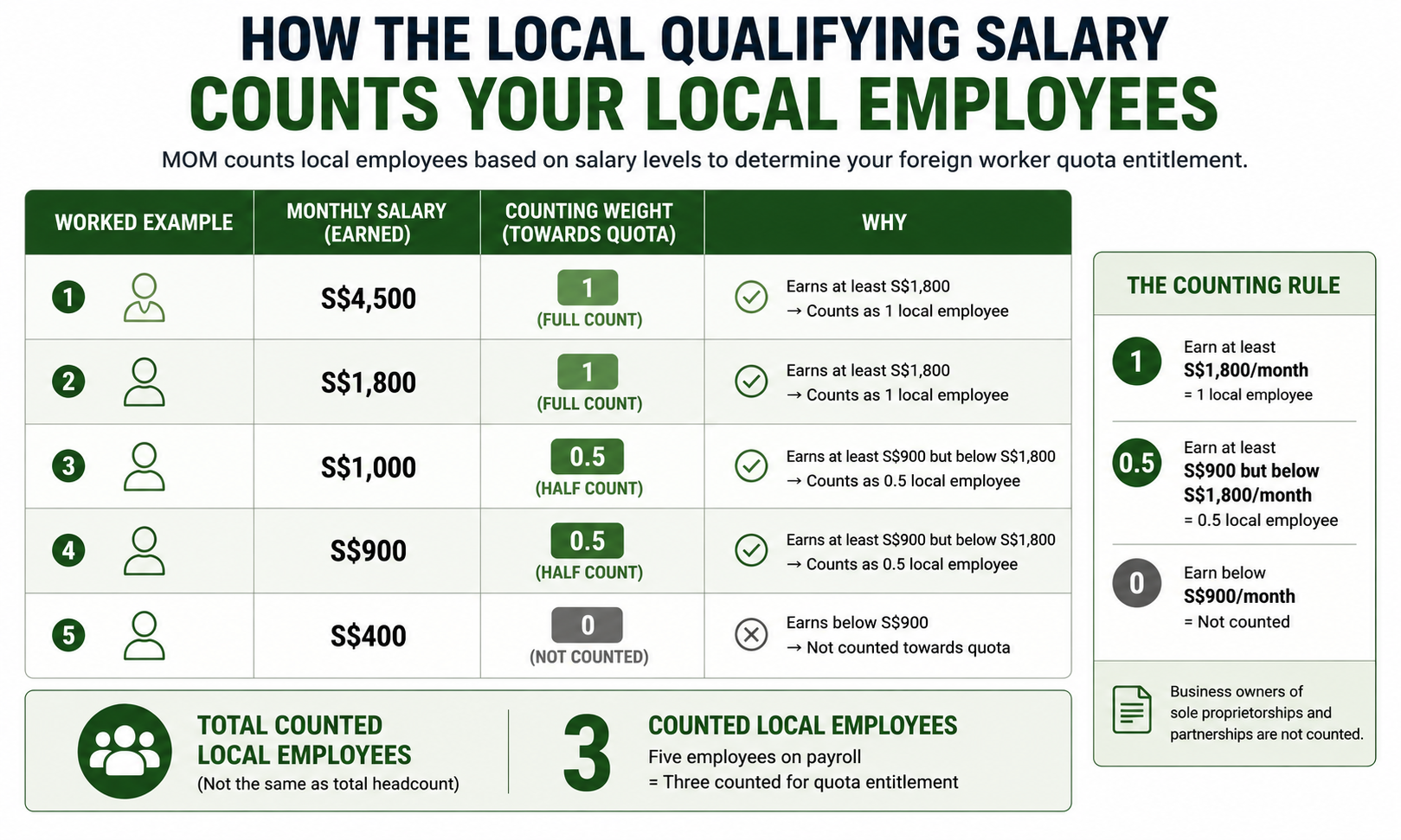
A Singaporean or Permanent Resident employed under a contract of service, the company’s own director included, is counted as:
- 1 local employee if they earn at least S$1,800 per month
- 0.5 local employee if they earn at least S$900 but below S$1,800 per month
- Below S$900, the employee is not counted at all
A worked example makes the effect concrete. Five employees earning S$4,500, S$1,800, S$1,000, S$900 and S$400 produce a total of three counted local employees, not five. The first two count as one each. The next two count as half each, making one between them. The employee at S$400 contributes nothing to quota entitlement.
Two more things. Business owners of sole proprietorships and partnerships aren’t counted. And a newly hired employee only shifts your quota once you’ve paid their first full-month salary and CPF contribution, so anyone planning a hire against quota headroom that doesn’t exist yet should build that lag in.
What changed on 1 July 2026
The full-count threshold rose from S$1,600 to S$1,800, and the half-count band now sits at S$900 to below S$1,800. The part-time hourly equivalent moved at the same time, from S$9.00 to S$10.50 an hour.
The important point is structural, not numerical. Because the counting bands moved upward, an employer whose local salaries sat between the old and new thresholds saw their counted local headcount fall on 1 July without any change to their actual workforce. Full counts became half counts. Half counts became zero.
Quota entitlement is derived by applying your sector’s Dependency Ratio Ceiling to that counted local figure. Shrink the base and the ceiling calculation returns a smaller number.
Why employers find out late
Nothing about this generates an alert. There’s no letter saying your entitlement dropped.
What happens instead is that a Work Permit application gets rejected, or a renewal doesn’t go through, and someone works backward from the rejection to discover the quota base moved months earlier. By that point the project is already staffed on an assumption that no longer holds.
Three situations produce the sharpest surprises.
Companies with part-time and lower-wage local staff are the most exposed. Cleaners, service crew, admin staff sitting near the threshold are exactly the salaries that cross a counting band when it moves.
Local attrition is the second. A local resignation is a headcount problem in most managers’ minds. It’s also a quota problem, and the three-month averaging delays the effect.
Third is sector misclassification. Each sector carries a different Dependency Ratio Ceiling, and the S Pass sub-quota differs too. MOM caps S Pass holders at 10% of total workforce in services and 15% in construction, manufacturing, marine shipyard and process. A company classified into the wrong sector can be planning against a ceiling that was never theirs.
Working out your real headroom
The practical sequence for an employer who hasn’t checked since July.
Start with your CPF records, not your headcount list. The quota is computed from what you actually paid and declared, not from how many names sit on the org chart.
Apply the counting rule employee by employee. Full count at S$1,800 and above, half count from S$900 to below S$1,800, nothing below S$900. Exclude sole proprietorship and partnership owners.
Remember the three-month average. A salary increase implemented this month doesn’t restore your entitlement this month.
Then check both ceilings. You need to sit within the overall Dependency Ratio Ceiling for your sector and within the S Pass sub-quota at the same time. Employers occasionally clear the first and breach the second.
MOM publishes a Foreign Worker Quota Calculator, and using the official tool beats working from a consultancy summary. Including this one. Sector ceilings and levy rates get revised, and secondhand figures go stale quickly.
Raising salaries versus restructuring the workforce
Employers facing a quota shortfall generally have two levers, and they suit different situations.
Raising local salaries to the counting threshold restores quota entitlement directly, and there’s co-funding support in the picture. The Progressive Wage Credit Scheme co-funds wage increases for lower-wage Singaporean employees, with disbursements based on CPF contribution data.
Restructuring how the work is resourced suits situations where the salary increase isn’t commercially viable across the affected headcount, or where the manpower need is project-bound instead of permanent. Outsourced or contract-based arrangements shift where the headcount sits. This needs structuring properly and not treating as a workaround, because MOM looks at the substance of the employment relationship and quota rules apply to genuine employees you pay CPF for. For project-bound site manpower specifically, our overview of construction manpower outsourcing in Singapore sets out how these arrangements are usually built, and our manpower outsourcing services page covers the wider sector coverage.
Employers rebuilding a project team should also confirm which statutory appointments the project triggers before mobilizing. WSHO and WSH coordinator appointments sit under MOM, while construction sites above a defined contract sum separately need an Environmental Control Officer registered with NEA.
Neither lever works retroactively. Both take a full salary and CPF cycle to show up in your computed entitlement.
Frequently asked questions
Is the Local Qualifying Salary a minimum wage? No. The LQS determines how local employees are counted toward your Work Permit and S Pass quota entitlement. It’s a quota counting rule, not a general wage floor.
How does MOM count a local employee earning S$1,200 a month? As 0.5 of a local employee, since that salary falls in the S$900 to below S$1,800 band.
Does the company director count toward quota? A director employed under a contract of service is counted, subject to the same salary bands. Business owners of sole proprietorships and partnerships aren’t counted.
How quickly does a new local hire increase my quota? Only after you’ve paid their first full-month salary and made the CPF contribution. The quota also runs on a three-month average of local employees, so the effect isn’t immediate.
What is the S Pass sub-quota? S Pass holders are capped at 10% of total workforce in the services sector and 15% in construction, manufacturing, marine shipyard and process. This sits inside your overall foreign worker quota, so both limits apply at once. Our guide to choosing between EP, S Pass and Work Permit covers how this shapes hiring decisions.
Why did my quota drop when nobody resigned? Most often because a counting threshold moved and local salaries didn’t move with it, converting full counts into half counts. The three-month averaging means the drop appears some weeks after the underlying change.
Check the base before you plan the hire
Foreign workforce planning in Singapore fails at the base of the calculation far more often than at the ceiling. Employers know their sector’s DRC. Fewer track the counted local figure the DRC gets applied to, and that figure moves with payroll, attrition and policy changes that arrive without notice.
ProSkill Workforce Pte Ltd provides manpower outsourcing across construction, marine, manufacturing, logistics, facilities and engineering in Singapore, along with recruitment services for permanent placement and WSH consultancy where a project needs both manpower and compliance support.
Related reading: Construction manpower outsourcing in Singapore · Engineering recruitment agency services · Employment Pass, S Pass or Work Permit? · What a manpower recruitment agency should deliver
If quota headroom is constraining a project, tell us the roles, the duration and your sector, and we’ll set out what’s workable. Call +65 9090 0468 or email inquiry@proskillworkforce.com.