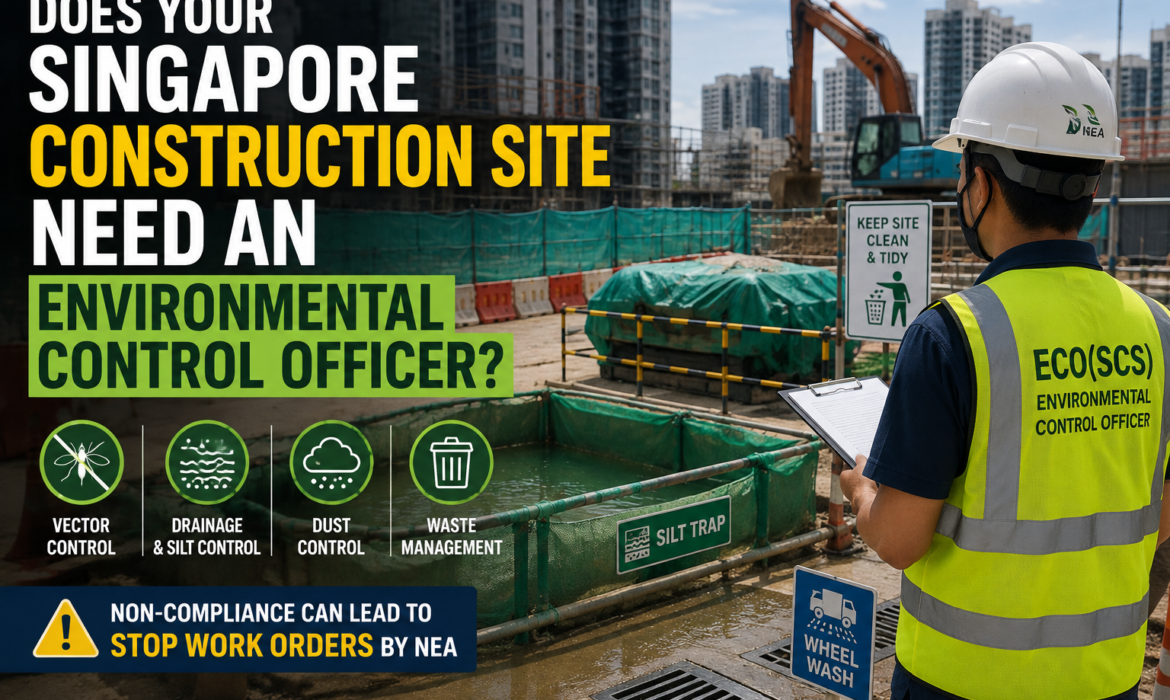
Does Your Singapore Construction Site Need an Environmental Control Officer?
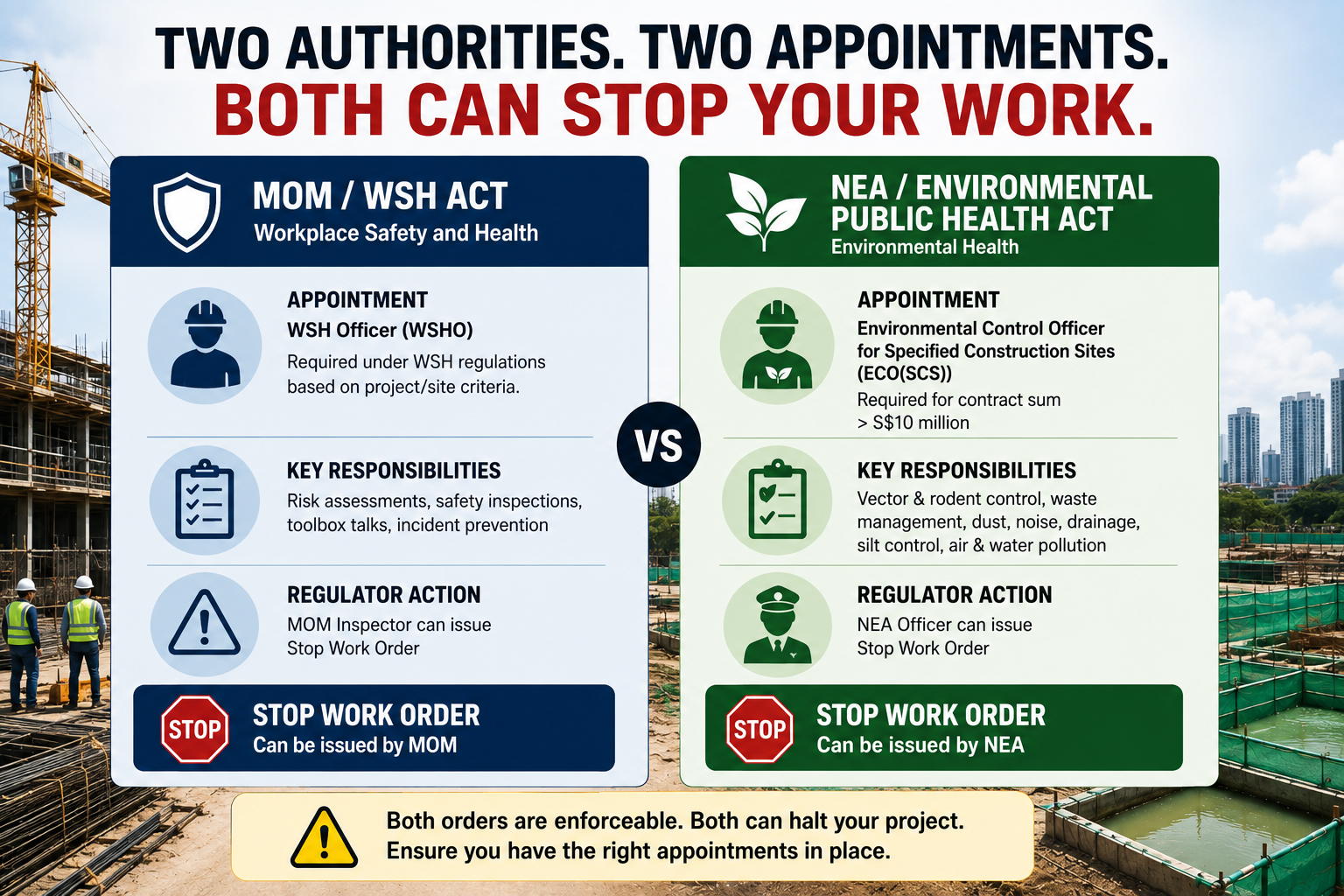
Most contractors in Singapore have their MOM appointments mapped out. The safety officer is registered, the risk assessments are filed, the toolbox briefings run on schedule. What many don’t have is a registered Environmental Control Officer. Then a National Environment Agency officer arrives, finds mosquito breeding across several habitats, and issues a Stop Work Order.
Work stops just as completely as it would under an MOM order. The difference is that this one comes from a different agency, under different legislation, for reasons that have nothing to do with your WSH management system. Sites that are genuinely well run on safety still get caught here, because environmental compliance sits under its own appointment and its own regulator.
That appointment is the Environmental Control Officer.
What an Environmental Control Officer is, and which law creates the requirement
The ECO scheme is administered by NEA under the Environmental Public Health Act. Registration and appointment obligations are set out in the Environmental Public Health (Registration of Environmental Control Coordinators and Environmental Control Officers) Regulations 2021.
For construction, the relevant registration is the Environmental Control Officer for Specified Construction Sites, written as ECO(SCS). Its duties are set out in NEA’s Code of Practice for ECO(SCS). This is a registered appointment, not an internal job title. An individual applies to NEA for a Certificate of Registration, and the appointment is only valid once that registration is in place.
The role is preventive by design. An ECO(SCS) watches for conditions on site that create environmental or public health problems, raises them with the occupier, and recommends corrective measures before they escalate into an enforcement matter. Our Environmental Control Officer services page covers how the role is typically deployed on Singapore projects.
When the appointment is triggered
The trigger is contract sum. In a written parliamentary reply on contractors violating environmental laws, the Ministry of Sustainability and the Environment set out that occupiers of specified construction sites with contract sums exceeding $10 million are required to appoint an ECO(SCS).
The required commitment scales with project size. NEA’s Code of Practice defines a part-time ECO as one employed for at least 15 hours per week and a full-time ECO as one employed for at least 40 hours per week, with part-time coverage applying between $10 million and $50 million and full-time coverage above $50 million. Confirm your band against the current Code of Practice before scoping an engagement, because the hours are part of the requirement and not a service preference.
Note that this threshold is completely separate from the contract-sum threshold that triggers a WSH Officer appointment under MOM’s regulations. The two don’t align, and satisfying one does nothing for the other. A project can sit above the ECO threshold and below the WSHO threshold, or the reverse. If you haven’t yet worked out which MOM appointment your project needs, our workplace safety and health officer page covers that side.
Operating a specified construction site without a valid ECO where one is required is an offence under the Environmental Public Health Act.
What the ECO actually produces
Two documents anchor the role.
The Site Environmental Control Programme (SECP) sets out the environmental management plan for the site before and during works. How the project will handle the environmental risks its own activities create.
The Site Environmental Control Report (SECR) is the recurring record. The ECO prepares and submits it to the occupier of the construction site at least once a month, or at another frequency NEA specifies after works commence. The report must be made available for inspection on demand by the Director-General of Public Health or a Public Health Officer, through the occupier.
Day to day, the scope covers vector and rodent control, solid waste management and disposal, general site housekeeping, NEA construction noise limits and dust control, drainage and silt control, and air and water pollution.
One provision deserves attention from occupiers specifically. The occupier of the construction site is required to take and follow the advice given by the ECO(SCS) in maintaining environmental health standards. This isn’t an advisory role the site team can note and set aside. If your ECO raises an issue and nothing happens, the exposure sits with the occupier.
Why this matters more than contractors expect
The enforcement picture in Singapore isn’t theoretical.
In a written parliamentary reply on dengue prevention, the Ministry of Sustainability and the Environment set out that contractors whose sites are found with mosquito breeding may face a fine of up to S$20,000, imprisonment for up to three months, or both. Repeat offenders face up to S$50,000, up to six months’ imprisonment, or both.
Sites with poor housekeeping and conditions favorable to mosquito breeding may be issued Stop Work Orders, with the site operator required to undertake specified remedial measures. Those measures have to be implemented and verified by NEA before the order is lifted. The site doesn’t restart on the contractor’s timetable.
The volume has moved in the wrong direction over time. The same reply noted that 65 Stop Work Orders had been issued to construction sites as of 13 June 2022, against 43 across the whole of 2021 and 37 in 2020.
For a project under schedule pressure, an environmental Stop Work Order is expensive in a way that’s hard to recover. Preliminaries keep running. Subcontractors sit idle. And the restart depends on an external verification you don’t control. Repeat offences also surface during tender evaluation, which extends the cost well past the project where the lapse occurred.
ECO(SCS), ECO(SP) and ECC are not interchangeable
NEA’s environmental appointments cover more than construction, and the naming causes real confusion.
ECO(SCS) applies to specified construction sites, as described above.
ECO(SP) applies to specified premises under the environmental sanitation regime. Specified premises generally require an Environmental Control Coordinator, while more complex premises require a registered ECO(SP). Shopping malls are among them, designated under the Environmental Public Health (Designation of Specified Premises — Shopping Malls) Order 2022.
ECC, the Environmental Control Coordinator, is the coordinator-level appointment for specified premises, working alongside an ECO(SP) where one is required.
If you operate both a construction project and a commercial premises, these are different registrations with different scopes. One person’s certificate doesn’t automatically cover the other context.
Registration and upkeep
Applications for ECO(SCS) registration go through the GoBusiness licensing portal. An individual can apply with Singpass, and a Corppass account isn’t required for the individual registration itself. NEA’s stated processing time is within 30 working days, which is worth building into your mobilization schedule instead of discovering at the last minute.
Entry requirements are pitched at construction site supervisors. GoBusiness lists the standard as Workplace Literacy and Numeracy Level 7 across all five assessments — reading, listening, speaking, writing and numeracy — or Level 6 across all five together with two years of relevant working experience.
NEA also requires ECO(SCS) applicants to hold a course certificate of performance obtained within the five years preceding the application or renewal date. Anyone searching for an ECO course should confirm the provider is recognized for this purpose before enrolling. Registration isn’t permanent, and lapsed currency is a common reason an appointment stops being valid without anyone noticing.
Running environmental and WSH appointments together
Most contractors already treat safety as a planned function. Environmental compliance tends to get handled reactively, which is why it produces surprises.
A few practical points help.
Confirm the ECO requirement at tender or pre-mobilization, not after work starts. The registration lead time alone makes late appointment difficult. Check whether your project needs part-time or full-time coverage before you scope the engagement, since the hours commitment is part of the requirement and not a service preference.
Give the ECO a route to get things fixed. The regulations require the occupier to follow the ECO’s advice, so there should be a named person who receives SECR findings and owns closure. An ECO producing monthly reports nobody actions is a compliance record of unaddressed problems.
Fold environmental checks into the same site walk as safety inspections where it makes sense. Water ponding, blocked drainage, sagging tarpaulins and poor housekeeping show up on a WSH inspection anyway, and it’s the same ground a toolbox safety briefing already covers. The distinction is that under the environmental regime they carry their own penalties and their own Stop Work Order risk.
Frequently asked questions
Is an ECO the same as a WSH Officer? No. A WSH Officer is registered with MOM under the Workplace Safety and Health framework. An ECO is registered with NEA under the Environmental Public Health Act. They cover different risks, have different appointment triggers, and are enforced by different agencies. Sites frequently need both.
Can our WSHO also act as our ECO? Only if that individual separately holds valid ECO(SCS) registration. Holding one appointment doesn’t confer the other. Whether one person can carry both on a given project also depends on the required hours commitment for each.
Can an ECO be part-time? For mid-sized projects, part-time appointment with a minimum weekly hours commitment is the expected arrangement. Larger projects require full-time coverage. Confirm which band your contract sum falls into before engaging.
What happens if NEA issues a Stop Work Order for mosquito breeding? Work halts, and the site operator must carry out specified remedial measures. NEA has to verify those measures before the order is lifted, so the restart timing isn’t within the contractor’s control.
How long does ECO registration take? NEA’s stated processing time is within 30 working days for an ECO(SCS) Certificate of Registration. Plan for this in your mobilization timeline.
Do shopping malls and commercial premises need an ECO? Under the environmental sanitation regime, specified premises generally require an Environmental Control Coordinator, while more complex premises such as designated shopping malls require a registered ECO(SP). That’s a different registration from the construction-site ECO(SCS).
Get the appointment in place before mobilization
The pattern behind most environmental enforcement on Singapore sites isn’t indifference. It’s sequencing. The requirement gets confirmed after the site is already active, the registration takes time, and the gap between mobilization and appointment is exactly when housekeeping standards slip.
ProSkill Workforce Pte Ltd places Environmental Control Officers alongside WSH professionals for construction and industrial projects in Singapore, with WSH consultancy covering risk assessments, safety audits and incident investigation where a project needs both sides covered by one partner.
Related reading: Workplace safety and health officer services · Construction manpower outsourcing in Singapore · WSH risk assessment services
Tell us your contract sum, project duration and site type, and we’ll tell you which appointments apply and what coverage level the project needs. Call +65 9090 0468 or email inquiry@proskillworkforce.com.