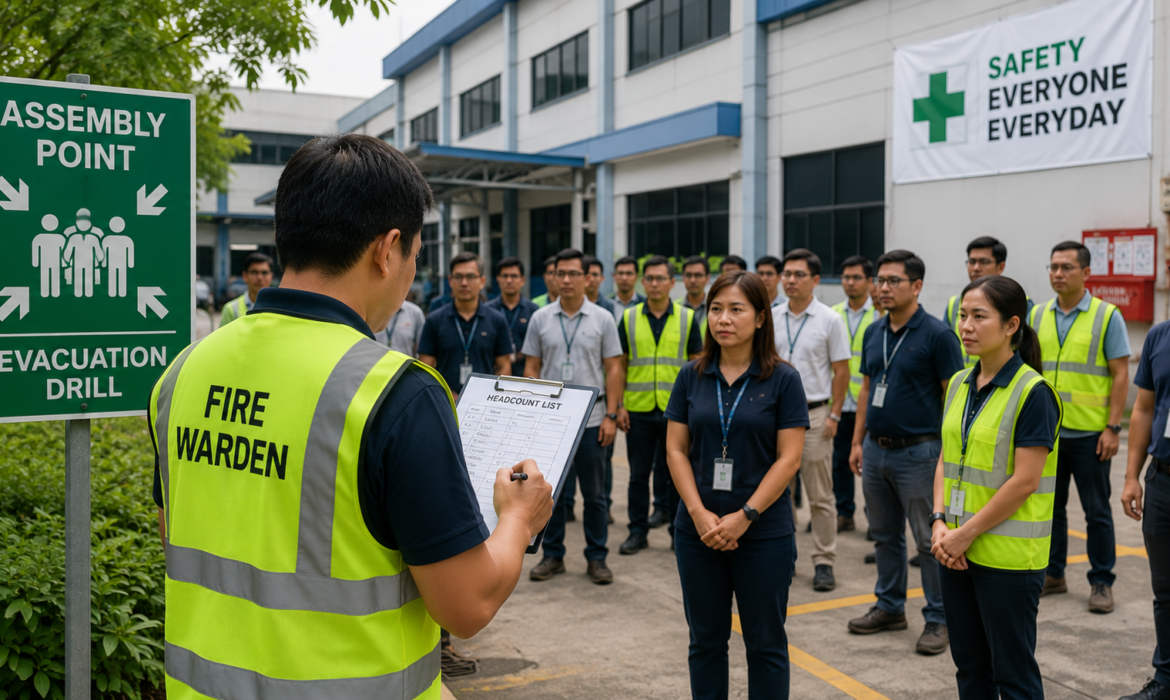
Most emergency response plans in Singapore are technically adequate and practically untested. They name a fire warden who left last year, assume an assembly point that’s now a works compound, and give a rescue procedure nobody has rehearsed.
None of that is visible until something happens. Which is the problem with treating the plan as a document instead of a capability.
Why the plan is required at all
Emergency preparedness sits across several Singapore obligations instead of in one place, which is partly why it gets fragmented in practice.
Under the WSH framework, risk management requires you to identify and control the foreseeable emergency scenarios your work activities create. Specific regulations layer in their own requirements. The WSH (Work at Heights) Regulations, for instance, sit behind the expectation that a fall prevention plan includes rescue arrangements, because a worker suspended in a harness needs retrieval within minutes. Not hours. Our guide to work at height plans and permits covers where that sits in the wider system.
On the fire side, meanwhile, premises requiring a Fire Certificate operate under SCDF’s regime, and buildings with a Fire Safety Manager have emergency planning and drill responsibilities attached to that appointment.
What an emergency response plan needs to contain
The scenarios differ by workplace. The structure of a workable plan, however, doesn’t.
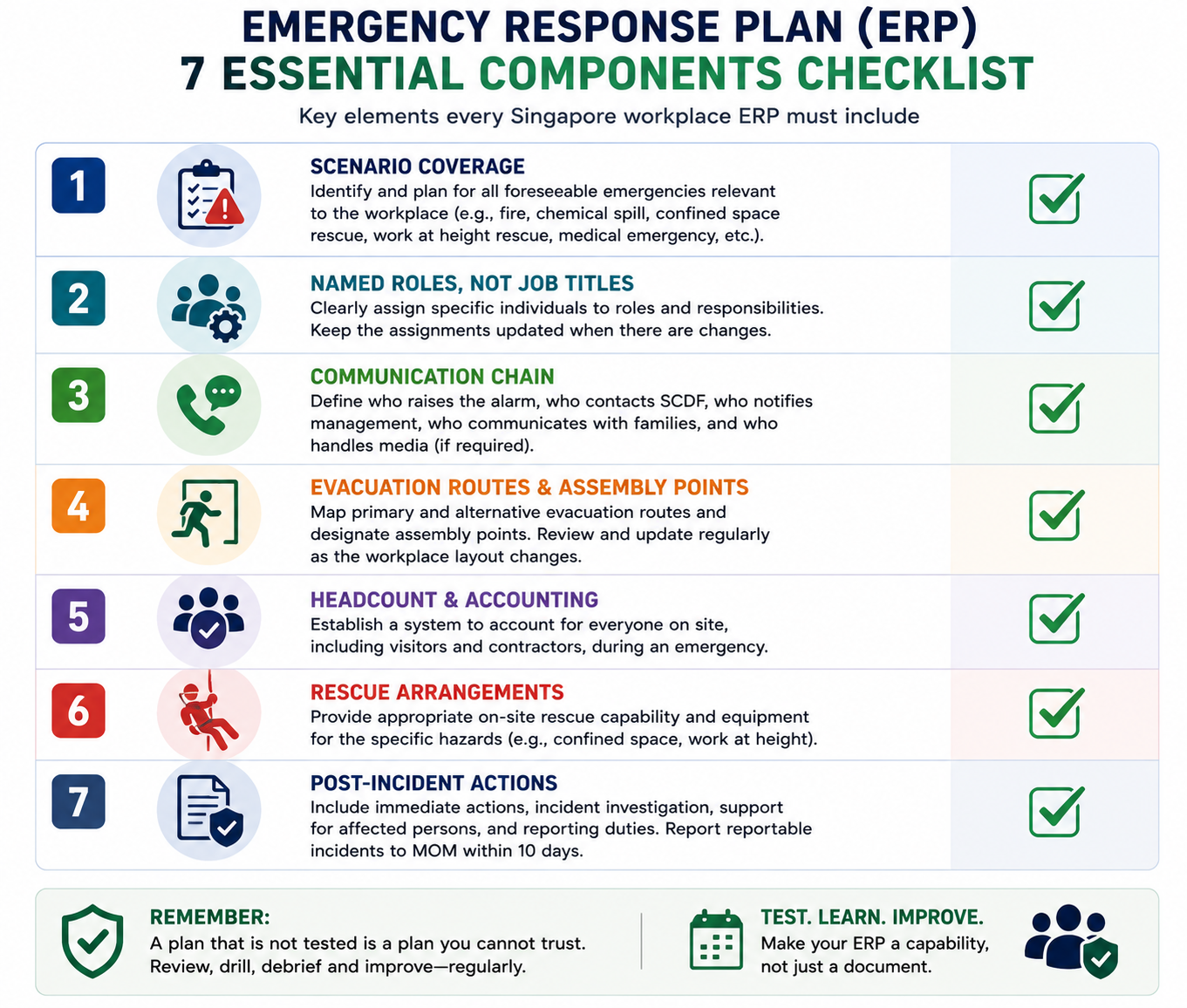
Scenario coverage
Fire is the default and it isn’t the only one. Depending on the workplace: chemical spill or release, confined space rescue, work at height rescue, structural collapse, medical emergency, gas leak, power failure affecting critical systems. So a plan covering only fire, on a site running confined space work, is incomplete.
Named roles, not job titles
The plan should say who does what, and that assignment needs a maintenance process, because people leave. A plan naming a departed employee as incident controller is worse than no plan, since it creates false confidence. Fire warden responsibilities in particular tend to get handed out once at fit-out, and nobody revisits them.
Communication chain
Who raises the alarm, who calls SCDF, who notifies management, who speaks to families, who handles media if it comes to that. Under pressure, that order matters more than the content of any single call.
Evacuation routes and assembly points
These change on active sites more often than plans get updated. A construction project’s assembly point at month two may sit inside the works by month eight.
Headcount and accounting
Knowing who was on site is the difference between a controlled evacuation and firefighters searching a building for someone who went home early. On multi-contractor sites this is genuinely difficult and needs a system, not an intention.
Rescue arrangements
Specific to the hazards present. Confined space and work at height both need rescue capability on site, not a plan to call for help.
Post-incident actions
Including the reporting duty. A reportable incident must go to MOM within 10 days, and our guide to workplace accident reporting covers what counts and when the clock starts.
Drills are the part that matters
A plan nobody has rehearsed is a hypothesis.
Drills surface what a desk review can’t. The alarm turns out to be inaudible in one wing of the building. Rain floods the assembly point. Your designated first aider works nights, so he has never once attended. And nobody can find who holds the key to the emergency exit that security keeps locked.
A few principles make drills useful instead of performative. First, vary what you rehearse.
A workplace that only ever drills a ground-floor fire alarm at 10am on a Tuesday rehearses one narrow case. Include contractors and visitors, because they’re on site and they don’t know your building. Time it and record it, since evacuation time is the metric that tells you whether the plan works and without a recorded baseline you can’t tell whether anything improved.
Then debrief honestly and act on it. The value is in the findings. A drill that generates a list of problems nobody closes has cost you an hour and taught you nothing.
Finally, keep records. Drill records are what you produce when an auditor or authority asks, and they’re evidence of a functioning system instead of a filed document.
Required drill frequency varies by premises type, and by whether you have appointed a Fire Safety Manager. Confirm what applies to your building against SCDF requirements. Our fire drill planning and execution page covers how these are usually run and documented.
Where plans fail in practice
The plan lives with one person. So when that person takes leave, the capability goes with them.
Someone wrote it for a different site. Template plans that travel between projects rarely match the actual layout, hazards or neighbours.
Nobody owns updates. A plan needs revisiting whenever the layout changes, whenever you introduce new work types, whenever key personnel change, and after any incident or drill that reveals a gap.
Contractors sit outside it. On a multi-employer site the emergency plan needs to cover everyone present, and subcontractors need briefing as part of induction, not at the point of an alarm. A standing toolbox briefing routine is the usual mechanism for keeping that current.
Teams assume rescue instead of resourcing it. “Call SCDF” isn’t a confined space rescue plan. Where a hazard requires on-site rescue capability, that capability needs to exist on site.
Who should own it
On premises with a Fire Safety Manager, that appointment is the natural home for fire emergency planning and drills. Our page on Fire Safety Manager services in Singapore sets out how we scope the role. On worksites it typically sits with the WSH Officer or WSH coordinator, integrated with the risk assessment and permit systems instead of run separately.
The integration point matters. Emergency planning built from the risk assessment covers the scenarios your work actually creates. Emergency planning built from a template, on the other hand, covers only the scenarios its author imagined. Where a business wants the plan developed and tested instead of filed, our emergency response plan consultancy covers that scope.
For premises carrying both fire and WSH obligations, which is most industrial and many commercial sites, the sensible arrangement is one calendar covering drills, inspections, audits and certificate renewals together. Buildings holding a Fire Certificate should note that the three-year FC regime introduced in April 2026 changed the renewal cycle but left annual professional engineer inspections in place, so those obligations still need tracking yearly.
Frequently asked questions
Does every Singapore workplace need an emergency response plan?
Emergency preparedness obligations arise from the risk management framework and from specific regulations, depending on the hazards present and the premises type. In practice, any workplace with foreseeable emergency scenarios needs a plan. The formality required scales with the risk.
How often should we run a fire drill?
Requirements vary by premises type and appointment. Confirm the applicable frequency for your building against SCDF requirements. Where you have appointed a Fire Safety Manager, check the duties attached to that role as well.
What are a fire warden’s responsibilities during an evacuation?
Typically raising and relaying the alarm, sweeping an assigned zone, directing occupants to the correct route, and accounting for people at the assembly point. Specific duties depend on your building’s plan and the appointments in place, so define them in writing instead of by convention.
Who should take part in a drill?
Everyone present. Employees, contractors and visitors. Contractors usually know the building least well, so a headcount misses them most often.
What records should we keep?
The plan itself with its revision history, drill records including evacuation times and findings, debrief outcomes and the corrective actions taken, and training or briefing records for the named roles.
Does the plan need to cover rescue, or is calling SCDF enough?
Where a work activity creates a hazard requiring immediate on-site rescue, confined space entry and work at height being the clearest cases, you need to plan and resource that capability on site. Emergency services are part of the response, not a substitute for it.
What should trigger a plan update?
Layout changes, new work activities or hazards, changes in key personnel, findings from a drill, and any actual incident.
Test the plan before it gets tested for you
Drills measure the distance between a compliant plan and a working one. Everything else — the document, the roles, the routes — is only as good as the last time someone checked whether it functions.
ProSkill Workforce Pte Ltd provides emergency response planning and preparedness as part of its WSH consultancy for Singapore workplaces, and places Fire Safety Managers and WSH professionals with building owners, occupiers and contractors.
Related reading: Fire Safety Manager services in Singapore · Singapore’s three-year Fire Certificate regime · Reporting a workplace accident to MOM · Work at height: plans, permits and who needs what
Tell us your premises type and current plan status, and we’ll set out what a review would cover. Call +65 9090 0468 or email inquiry@proskillworkforce.com.