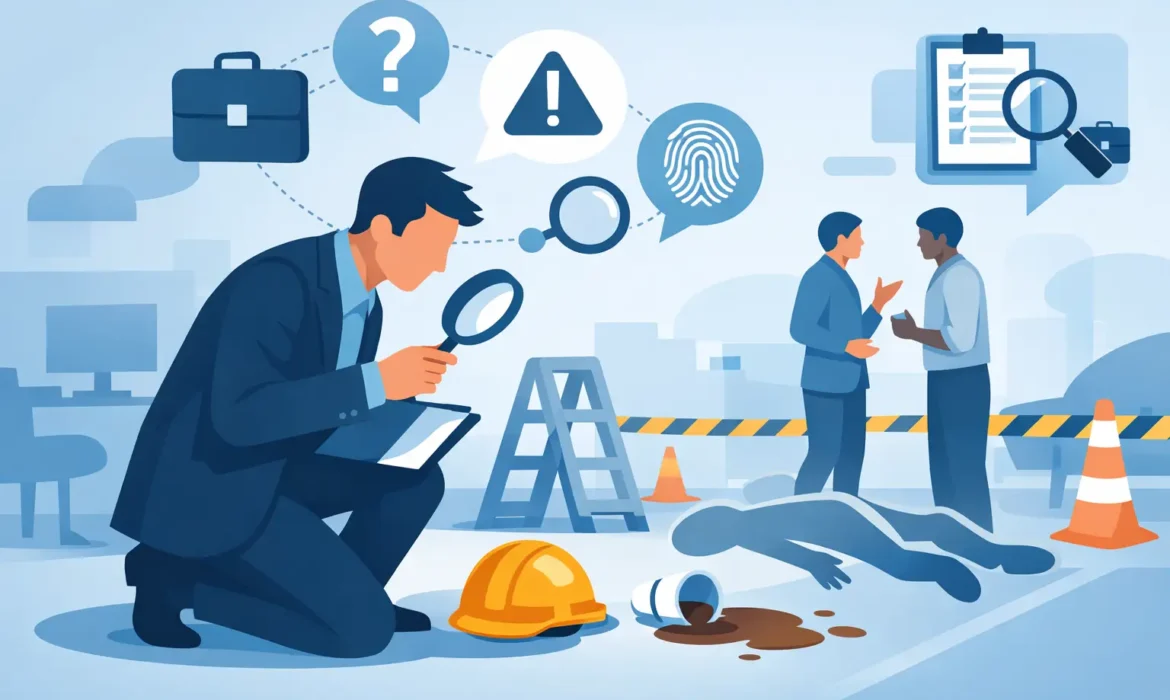
A serious incident can disrupt far more than one shift. It can stop work, unsettle employees, delay a project, expose gaps in supervision, and place management under immediate pressure to explain what happened. A workplace incident investigation consultant brings independent technical discipline to that moment, helping employers establish the facts, address immediate risks, and turn a difficult event into meaningful prevention.
For construction sites, industrial facilities, logistics operations, commercial properties, and engineering projects, the quality of an investigation matters long after the initial report is filed. A rushed review may identify the person closest to the event. A well-managed investigation identifies the conditions, controls, decisions, and system failures that allowed it to happen.
What an Incident Investigation Consultant Does
A workplace incident investigation consultant supports employers after accidents, near misses, dangerous occurrences, property damage, equipment failures, fires, and occupational safety events. The role is not simply to complete paperwork or assign blame. It is to conduct a structured, evidence-based examination that produces practical corrective action.
The work usually begins with evidence preservation. Depending on the incident, this may involve securing the work area, photographing conditions, reviewing equipment status, collecting permits and work records, examining risk assessments, and preserving relevant CCTV footage. Timing is critical. Site conditions can change quickly once operations resume, and memories become less reliable with each passing day.
The consultant then interviews relevant personnel, which may include injured employees, witnesses, supervisors, subcontractors, maintenance teams, safety personnel, and project leaders. Interviews should be approached carefully. Employees need sufficient confidence to explain what they observed without feeling that the process is designed to find a scapegoat.
From there, the investigation connects the evidence to the work system. Were workers competent and properly briefed? Was the method statement suitable for the actual site conditions? Was the equipment maintained, inspected, and fit for purpose? Did production pressure, staffing shortages, poor communication, or weak supervision influence the work? These questions move the analysis beyond the immediate act or error.
When External Investigation Support Is the Right Choice
Internal safety teams often understand a site better than anyone. They know the workforce, contractors, equipment, and operational history. For routine low-risk events, an internal investigation may be appropriate and efficient.
External support becomes particularly valuable when the event is serious, complex, repeated, or likely to be scrutinized by clients, insurers, regulators, or senior leadership. Independence can also matter when managers, supervisors, procedures, or internal decisions may form part of the investigation.
Consider engaging an external specialist when an incident involves:
- A fatality, serious injury, hospitalization, or high-potential near miss
- Multiple contractors, unclear responsibilities, or a disputed sequence of events
- Significant plant, machinery, electrical, lifting, fire, or process safety failure
- A recurring incident pattern despite previous corrective actions
- Concerns about impartiality, documentation quality, or investigation capability
- A major project delay, client escalation, insurance matter, or regulatory inquiry
The decision is not always about the severity of the injury alone. A near miss involving a suspended load, confined space entry, vehicle-pedestrian interaction, energized equipment, or hazardous substance may warrant the same level of attention as an injury event. The potential consequence is often the more useful measure.
A Reliable Investigation Follows the Evidence
An effective investigation should have a defined scope, clear roles, and a documented method. It should distinguish between verified facts, witness accounts, assumptions, and findings that require further validation. This is especially important where several employers or subcontractors are working within the same area.
A consultant can map the event chronologically, from planning and mobilization through execution and response. This timeline may reveal small but important deviations: a permit issued without a required isolation, a toolbox briefing that did not cover a changed condition, a temporary worker deployed without adequate familiarization, or a supervisor managing too many simultaneous activities.
Root-cause analysis is most useful when it avoids simplistic labels. “Human error” may describe the last visible action, but it rarely explains the full event. People make mistakes in systems shaped by training, fatigue, design, maintenance, workload, communication, and leadership expectations. Corrective actions should therefore address the conditions that made the error possible or likely.
That does not mean individual accountability is ignored. Where deliberate disregard of a critical safety rule is supported by evidence, employers must respond fairly and consistently. The balance is to separate willful misconduct from predictable failure within an inadequate work system. A credible investigation does both.
From Findings to Corrective Action
The value of an investigation is measured by what changes afterward. A detailed report that sits in a shared folder will not protect employees or improve performance. Corrective actions need an owner, a deadline, a priority level, and a method for verifying completion.
Some actions can be implemented immediately. A damaged access route can be barricaded, a defective tool removed from service, or a missing exclusion zone established before work restarts. Other actions require greater planning, such as redesigning a lifting plan, revising contractor onboarding, upgrading machine guarding, or changing how maintenance shutdowns are scheduled.
The strongest action plans use more than reminders and retraining. Training is necessary when a competence gap exists, but it is a weak standalone response if the underlying issue is poor equipment design, unreasonable work sequencing, inadequate staffing, or unclear authority. Employers should ask whether the control changes the work environment or merely asks people to be more careful.
For example, after a forklift near miss, a toolbox talk may reinforce awareness. However, physical separation of pedestrian routes, revised traffic flow, designated loading zones, speed controls, and supervisory checks are likely to provide stronger protection. The appropriate solution depends on the site, but the principle remains the same: prioritize controls that reduce reliance on memory and individual judgment.
Documentation That Supports Compliance and Operations
In regulated sectors, investigation records must be clear enough to withstand internal review and external scrutiny. They should document the incident details, response actions, evidence considered, interviews conducted, causal analysis, corrective measures, assigned responsibilities, and follow-up status.
Good documentation also helps employers spot patterns across sites and projects. A single dropped-object event may appear isolated. Several events involving unsecured materials, rushed handovers, or incomplete pre-task checks point to a broader control problem. Consistent reporting makes those trends visible before they become more serious.
For Singapore employers, the investigation should align with workplace safety and health obligations, site rules, contractual requirements, and the organization’s safety management system. It should also reflect the realities of a mixed workforce, where language, literacy, labor supply, subcontracting structures, and changing project conditions can affect how safety controls are understood and applied.
Choosing the Right Investigation Partner
Technical capability matters. A consultant should understand the hazards relevant to your operations, whether those involve work at height, lifting operations, electrical systems, confined spaces, construction activities, industrial maintenance, vehicle movement, or facilities operations. Generic reports rarely provide the depth needed for complex workplaces.
Equally important is the ability to work professionally with frontline personnel and management. An investigation partner must ask difficult questions without creating unnecessary defensiveness. The goal is a reliable account of the event and a practical path forward, not a report filled with jargon or unsupported conclusions.
Before appointing a consultant, clarify the scope. Ask whether they will lead the investigation, support an internal team, review an existing report, provide root-cause analysis, develop corrective actions, conduct follow-up audits, or deliver workforce briefings. A bespoke scope is often more cost-effective than commissioning a broad review that does not match the event’s actual risk.
ProSkill Workforce combines workplace safety consultancy with practical knowledge of manpower deployment, contractor coordination, and site operations. That perspective can be particularly useful where incident findings affect not only safety procedures, but also competency requirements, supervision levels, workforce allocation, and contractor management.
A well-handled investigation should leave an organization with more than an explanation of the past. It should give leaders clearer controls, supervisors better direction, and employees confidence that lessons will be acted on before the next shift begins.