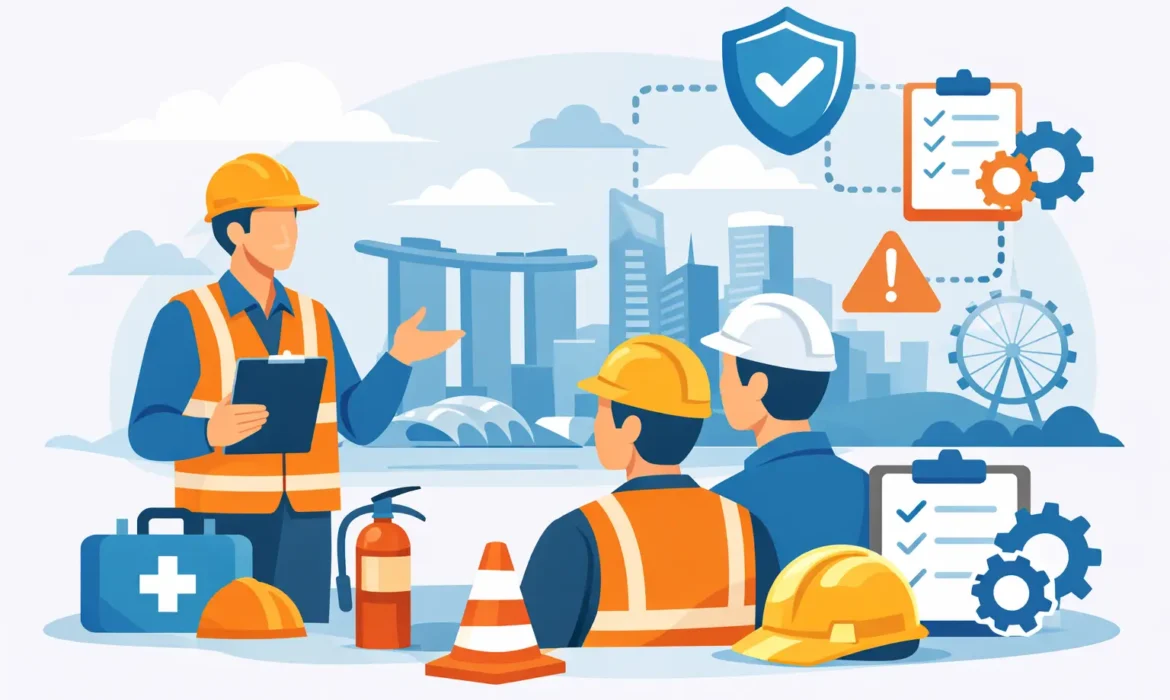
A missed risk assessment, an expired fire safety document, or a toolbox briefing that never reaches subcontractors can quickly become a project delay, an enforcement issue, or a serious injury. For employers managing active worksites and operational facilities, workplace safety consultancy singapore support should do more than produce paperwork. It should help leaders make safe work practical, visible, and consistent across every shift.
Construction, engineering, manufacturing, logistics, facilities, and commercial operations all face different exposures. A one-size-fits-all safety program may look complete on paper but fail when workers confront actual site conditions. Effective consultancy begins with understanding the work, the people performing it, the equipment in use, and the business pressures surrounding delivery.
What a Safety Consultant Should Solve
A reliable workplace safety consultant helps an employer convert regulatory obligations into clear operating controls. That includes identifying hazards before work begins, assigning responsibility, verifying implementation, and correcting gaps before they lead to an incident.
For a construction contractor, the immediate concern may be work at height, lifting operations, electrical work, excavation, or traffic management. For a facilities team, it may be contractor coordination, confined-space access, maintenance permits, chemical handling, or emergency preparedness. An office or retail operation may need stronger fire safety arrangements, evacuation procedures, ergonomic controls, and incident reporting discipline.
The deliverables should match those realities. A capable consultant does not simply hand over a generic safety manual. They review the workplace, assess its specific risks, develop usable documentation, train the workforce, and provide follow-through when work conditions change.
This is especially valuable for organizations without a full internal WSH team, as well as established companies that need specialist support for a new project, audit finding, shutdown, fit-out, or high-risk scope of work. External expertise can provide an independent view of controls that have become routine and, therefore, easy to overlook.
Workplace Safety Consultancy Singapore Services That Matter
Safety consulting is most effective when the individual services work together as a management system. Risk assessments, inspections, training, emergency plans, and incident reviews are connected. Weakness in one area often shows up somewhere else.
Risk assessments that reflect real work
Risk assessment is not a formality to be completed before mobilization and filed away. It is the basis for deciding how work will be performed safely. Good assessments identify the task, the people at risk, existing controls, remaining risk, and actions needed to reduce exposure to a manageable level.
The quality of the assessment depends on site knowledge. Consider a renovation project in an occupied building. Beyond the obvious construction hazards, the assessment may need to address public access, dust and noise, deliveries, fire exits, work sequencing, electrical isolation, and coordination with building management. The controls must be practical enough for supervisors and workers to apply without slowing work through confusion.
Risk assessments should also be reviewed when conditions change. A revised work method, new equipment, added subcontractor, weather event, or near miss can all justify an update. This is where a consultant who understands operations adds more value than a document-only provider.
Safety management systems built for use
A safety management system should give managers and supervisors a dependable way to control risk, not create unnecessary administrative burden. Its scale should fit the organization. A small contractor may require clear procedures, roles, registers, and reporting lines that can be managed by a lean team. A larger employer may need more detailed governance, audit schedules, performance indicators, and cross-site reporting.
Core elements commonly include safety policy, legal and other requirement registers, risk management procedures, safe work procedures, training records, inspection programs, permit controls, contractor management, emergency response, incident reporting, and corrective-action tracking. What matters is not how many documents exist. What matters is whether the people responsible understand their role and can show that controls are functioning.
There is a trade-off here. Excessive documentation can distract supervisors from the field. Too little documentation makes it difficult to demonstrate due diligence and maintain consistency. The right approach uses concise, relevant records supported by regular site engagement.
Inspections, audits, and corrective actions
Inspections identify immediate hazards. Audits evaluate whether the management system is working as intended. Both are necessary, but they serve different purposes.
A site inspection may identify an uncovered opening, damaged electrical cable, poor housekeeping, missing barricade, or incomplete work-at-height control. The issue should be assigned to a responsible person, corrected within an appropriate timeframe, and verified as closed. Repeated findings need a deeper review. If the same condition returns, the underlying cause may be weak supervision, unsuitable materials, poor planning, inadequate training, or unrealistic production expectations.
An audit looks at broader questions: Are risk assessments current? Are subcontractors properly inducted? Are emergency drills documented and evaluated? Are incident findings translated into preventive action? Management teams need this evidence to see where resources and accountability are required.
Training that changes behavior
Workers may hold required certifications and still need site-specific instruction. A new employee, outsourced worker, or subcontractor cannot be expected to know the layout, emergency arrangements, high-risk zones, reporting process, and local rules on arrival.
Toolbox briefings are valuable when they are short, relevant, and linked to work scheduled that day or week. A briefing before lifting operations, for example, should address the actual lift plan, exclusion zone, communication method, weather considerations, and roles of the lifting team. Repeating broad messages without a connection to current work can cause people to disengage.
Behavior-based safety programs can strengthen participation when handled constructively. Their purpose is to encourage observation, conversation, and early intervention, not to blame workers for system failures. Employees are more likely to report hazards when they see that management responds fairly and acts on what is raised.
Choosing the Right Safety Partner
The right consultancy relationship depends on your risk profile, internal capability, and project demands. A short-term inspection-only engagement may be suitable for a defined compliance gap. A complex industrial maintenance contract, construction program, or multi-site operation may need ongoing support, scheduled audits, on-call guidance, and workforce training.
When evaluating a provider, look beyond the proposal price. Ask whether the consultant understands your industry, can visit the workplace, and has experience with the types of risk your teams face. Clarify who will complete the work, how corrective actions will be tracked, and whether deliverables will be customized for your organization rather than adapted from a generic template.
It is also useful to consider how safety support connects with manpower planning. A well-written procedure has limited effect if the workforce lacks the competency, supervision, or language support to implement it. Employers engaging contractors, temporary personnel, and specialist trades need clear onboarding and supervisory arrangements from the outset.
ProSkill Workforce Pte Ltd combines workplace safety consultancy with recruitment and outsourced manpower support, helping employers align qualified personnel, site requirements, and compliance responsibilities. This integrated approach can be particularly useful when a project requires both safety expertise and dependable access to technical or operational talent.
Make Safety Part of Project Control
Safety performs best when it is included in planning discussions before workers arrive on site. Project managers should account for safe access, work sequencing, delivery routes, storage areas, permit requirements, supervision ratios, emergency arrangements, and contractor interfaces while schedules are still being built.
This does not mean every risk can be eliminated. Industrial and construction work will always involve operational pressures and changing conditions. The objective is to recognize exposure early, select proportionate controls, and make sure those controls remain effective as the work develops.
Leaders set the standard through their response to bad news. If a worker reports a near miss, a damaged tool, or an unsafe instruction, the response should focus first on making the condition safe and understanding why it occurred. This approach protects people while producing information that improves future planning.
A capable safety consultancy should leave your organization more self-sufficient, not permanently dependent. The strongest outcome is a workplace where managers know what good control looks like, supervisors can act with confidence, and workers trust that raising a concern will lead to meaningful action. That is how compliance becomes a dependable part of delivery rather than a last-minute scramble before an inspection.