
Are you planning to outsource fire safety manager Singapore? In the modern urban landscape of Singapore, where high-rise commercial buildings, industrial complexes, and dense residential hubs shape the skyline, fire protection is a critical element of survival. Fire hazards pose an existential threat to business continuity, corporate reputation, and human life. As regulations evolve and the Ministry of Manpower (MOM) alongside the Singapore Civil Defence Force (SCDF) tighten compliance frameworks under the Fire Safety Act, managing these risks internally has become increasingly difficult for businesses.
For property owners, facility managers, and enterprise leaders, the decision to outsource a fire safety manager is no longer just a tactical operational choice; it is a high-level strategic imperative.
Proskill Workforce Pte Ltd stands at the absolute forefront of this operational evolution. We provide highly certified, MOM-registered, and SCDF-compliant Fire Safety Managers (FSMs) on a flexible, outsourced basis. This comprehensive guide explores the shifting dynamics of fire safety compliance in 2026, the structural benefits of an outsourced safety model, and how specialized expertise safeguards your organizational assets.
Understanding the Role: What Does a Fire Safety Manager Do?
A Fire Safety Manager (FSM) is a specialized professional trained, examined, and certified by the SCDF. Their primary mandate is to ensure that the building or premises they oversee is fully compliant with the Fire Safety Act and all relevant subsidiary legislation.
When you choose to outsource a fire safety manager, that individual assumes full legal and operational responsibility for the preventive safety architecture of your facility.
Core Statutory Duties of an FSM
The responsibilities of a certified FSM are comprehensive, requiring a deep understanding of engineering, building architecture, and legal frameworks.
- Formulating Fire Safety Committees: Organizing and training an internal team of emergency responders, fire wardens, and safety marshals within the tenant ecosystem.
- Developing Emergency Action Plans (EAP): Crafting bespoke, highly detailed Emergency Action Plans and Fire Evacuation Procedures tailored to the exact physical layout of the building.
- Conducting Mandatory Fire Drills: Planning, executing, and documenting at least two comprehensive fire drills per year for the entire building occupancy, as legally mandated by the SCDF.
- Routine Fire Safety Inspections: Conducting systematic daily, weekly, or monthly site walks to identify fire hazards, check exit routes, and verify that fire doors are not obstructed or propped open.
- Maintenance Verification of Protection Systems: Ensuring that active fire protection systems—such as sprinklers, smoke detectors, fire alarms, hose reels, and gas suppression systems—are regularly serviced and certified by qualified contractors.
- Liaison with Authorities: Acting as the primary point of contact for SCDF officers during routine inspections, enforcement audits, or in the unfortunate event of an actual emergency.
The Strategic Shift: Why Outsource Fire Safety Manager in 2026?
As we move through 2026, the economic environment demands exceptional agility. Organizations are shedding unnecessary overhead to focus on core competencies. The traditional model of employing a full-time, in-house Fire Safety Manager is being rapidly replaced by the outsourced model.
1. Navigating Complex, Evolving Legislation
The SCDF regularly updates the Fire Code to account for modern architectural practices, such as the inclusion of mass engineered timber (MET) structures, massive solar PV installations on roofs, and industrial-scale energy storage systems (ESS). An in-house professional may lack the time or resources to constantly stay updated with these rapid updates. An outsource fire safety manager from a specialized agency like Proskill Workforce Pte Ltd lives and breathes these regulations daily, ensuring your facility never falls out of compliance.
2. Eliminating Recruitment and Retention Overheads
Hiring a certified FSM in Singapore is an expensive and time-consuming process. The market faces a distinct talent crunch for highly experienced safety professionals. When you hire internally, you are responsible for competitive salaries, Central Provident Fund (CPF) contributions, medical insurance, annual bonuses, and ongoing training fees.
By outsourcing, you convert a rigid, permanent fixed cost into a predictable, scalable operational expense.
3. Absolute Objectivity and Compliance Integrity
An internal employee can sometimes face subtle corporate pressure to overlook minor infractions or delay system repairs to avoid blowing a departmental budget. An outsourced FSM operates with absolute independence. Their allegiance is to the law, the safety of the building occupants, and the protection of your license to operate. They provide transparent, unbiased hazard reports that protect directors from catastrophic legal liability.

Engagement Models: Tailoring the Service to Your Facility
Not every building requires a full-time, 40-hour-a-week Fire Safety Manager. The SCDF categorizes buildings based on usage, floor area, and occupant load to determine whether a building requires a Senior FSM, a standard FSM, or a part-time arrangement.
Statutory Requirements vs. Outsourced Solutions
| Building Category | SCDF Statutory Criteria | Ideal Outsourcing Model | Key Operational Benefit |
| High-Risk/Large Industrial | Chemical plants, wafer fabs, massive warehouses, oil storage. | Dedicated On-Site FSM | Full-time presence to manage complex daily hazardous workflows. |
| Commercial/Mixed-Use Complex | Offices, shopping malls with occupant loads $> 1500$ people. | Rotational/Shared FSM | Cost-sharing across tenants while ensuring total compliance presence. |
| Small-to-Medium Public Premises | Designated public buildings with floor area $\ge 5000\text{ m}^2$. | Part-Time/Retainer FSM | Minimal overhead; pays exactly for statutory hours and drills required. |
| Multi-Site Portfolios | Logistics networks, multiple retail bank branches. | Integrated Portfolio Managed FSM | Standardized safety protocols across all physical assets. |
Active vs. Passive Fire Protection: The FSM’s Matrix
A masterful Fire Safety Manager looks at a building through a dual lens: Active Fire Protection (AFP) and Passive Fire Protection (PFP). When you choose to outsource a fire safety manager, they immediately perform a comprehensive audit across both domains to establish a baseline safety metric.
                  ┌─────────────────────────────────────────┐
                  │      FIRE SAFETY MANAGER AUDIT MATRIX   │
                  └────────────────────┬────────────────────┘
                                       │
                ┌──────────────────────┴──────────────────────┐
                ▼                                             ▼
  ┌───────────────────────────┐                 ┌───────────────────────────┐
  │  ACTIVE FIRE PROTECTION   │                 │  PASSIVE FIRE PROTECTION   │
  ├───────────────────────────┤                 ├───────────────────────────┤
  │ • Smoke & Heat Detectors  │                 │ • Fire-Rated Doors        │
  │ • Automated Sprinklers    │                 │ • Structural Fire Proofing│
  │ • Manual Fire Extinguishers│                 │ • Compartmentation Walls  │
  │ • Fire Alarm Intercoms    │                 │ • Intumescent Coatings    │
  └───────────────────────────┘                 └───────────────────────────┘
Optimizing Active Fire Protection
Active systems require mechanical or electrical triggers to suppress fire. Your outsourced FSM establishes a rigorous preventative maintenance schedule. They ensure that flow tests are performed on fire pumps, backup generators kick in within milliseconds during a power failure, and central control panels accurately map the location of triggered smoke detectors.
Safeguarding Passive Fire Protection
Passive protection is built into the very bones of your building. It contains the fire within a specific zone (compartmentation) to allow occupants time to escape. The FSM inspects structural elements to ensure that cable or pipe penetrations through fire walls are sealed with approved firestop materials, and that fire-rated doors maintain their integrity without warping.
Digital Transformation in 2026 Fire Safety Management
The year 2026 has witnessed a massive technological leap forward in facility operations. Gone are the days of tracking safety audits via messy clipboards and faded paper logbooks. A progressive outsource fire safety manager utilizes an integrated digital tech stack to provide unparalleled visibility.
1. BIM-Integrated Evacuation Modeling
Using Building Information Modeling (BIM), our modern FSMs can run digital simulations of fire outbreaks. This predictive analytics engine allows us to see how smoke will travel through specific ventilation shafts and identify bottleneck zones where occupants might get trapped during a mass evacuation. This insight allows for the optimization of escape signage and warden placement.
2. IoT-Enabled Fire Asset Tracking
By embedding QR codes or RFID tags onto every single fire extinguisher, hose reel, and break-glass point in your building, the auditing process becomes bulletproof. The outsourced FSM scans these assets during site walks, instantly uploading time-stamped inspection data to a cloud dashboard. Property owners can log in at any moment to verify the real-time compliance status of their entire asset portfolio.
3. AI-Powered Hazard Detection
Integrating safety software with your existing building CCTV system allows for real-time hazard detection. If a delivery driver blocks a designated fire exit door with a pallet of goods, or if smoke is detected in an unmonitored server room, the AI immediately alerts the outsourced FSM’s mobile application, allowing for rapid intervention before an emergency scales out of control.
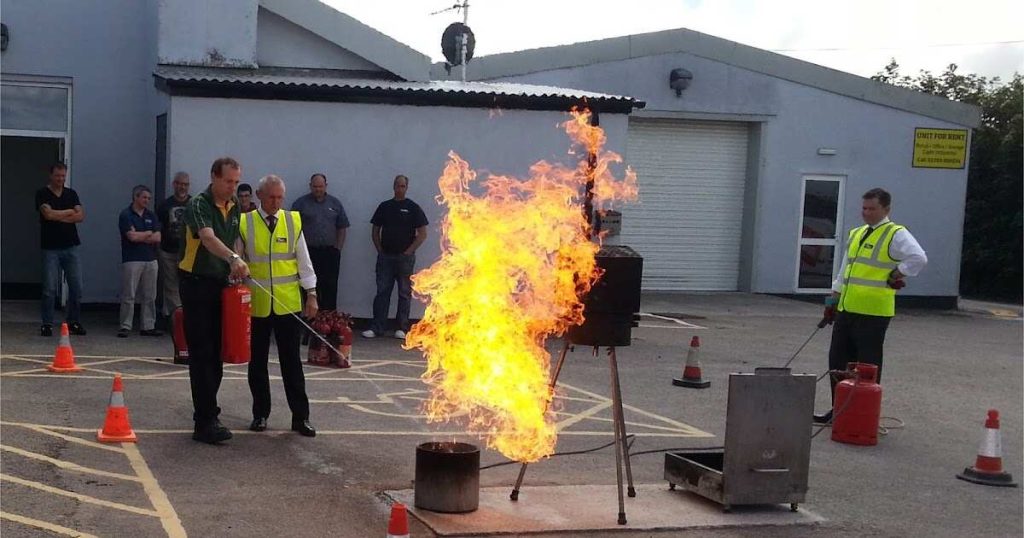
Why Choose Proskill Workforce Pte Ltd To Outsource Fire Safety Manager?
Selecting the right partner to outsource fire safety manager is a profound decision that directly impacts the safety of lives and the security of multimillion-dollar properties. Proskill Workforce Pte Ltd has established itself as the premier choice for corporate safety solutions in Singapore. Here is what sets our organization apart:
- Fully Certified & SCDF-Registered Specialists: Every single FSM within our ranks holds valid, verified certifications from the SCDF and is registered under the relevant regulatory frameworks. We do not use uncertified coordinators for statutory duties.
- Deep Cross-Industry Expertise: Our talent pool includes managers who specialize in diverse environments. Whether you operate a precision manufacturing plant, a high-traffic retail mall, a data center requiring clean-agent gas suppression, or a commercial office tower, we match you with a professional who understands your industry’s exact risk profile.
- Cost-Efficient, Flexible Engagement: We design bespoke service level agreements (SLAs) tailored precisely to your operational needs. You only pay for the exact level of coverage required by your building’s classification, maximizing your resource allocation.
- Proactive “Zero-Incident” Safety Culture: We do not believe in passive management. Our outsourced FSMs do not just wait for the bi-annual fire drill; they actively engage with your tenants, conduct regular safety briefings, and cultivate an organizational culture that prioritizes vigilance.
- Cutting-Edge Technical Execution: Our team is trained in the digital workflows of 2026, including BIM-led crisis mapping, cloud-based asset tracking, and smart compliance reporting. You receive digital, transparent proof of every inspection.
- Rapid Continuity Support: If your assigned outsourced FSM falls ill or travels, Proskill Workforce Pte Ltd instantly deploys an equally qualified substitute manager from our extensive team. Your facility is never left exposed or non-compliant for even a single day.
Step-by-Step Transitioning to an Outsource Fire Safety Manager Model
Switching from an in-house model or onboarding an FSM for a brand-new building is a streamlined process when partnering with Proskill Workforce Pte Ltd. We handle the heavy lifting to ensure a friction-free transition.
Step 1: Initial Building Safety Consultation
Our senior engineering team reviews your building’s architectural blueprints, past SCDF inspection records, current tenant footprint, and building classifications to understand the precise statutory requirements.
Step 2: Custom Service Level Agreement (SLA) Creation
We draft a clear, transparent contract detailing the exact frequency of site visits, the schedule for mandatory fire drills, report delivery timelines, and transparent pricing structures.
Step 3: Formal SCDF Appointment Lodgement
We handle the formal administrative submission via the SCDF’s e-services portal (CORENET/EPPA), officially registering our certified professional as the designated Fire Safety Manager for your specific address.
Step 4: System Integration and Baseline Audit
Our appointed FSM conducts an extensive baseline audit of all passive and active fire systems, initializes the digital QR tracking system on your fire assets, and establishes contact with all building tenant representatives.
FAQ: Frequently Asked Questions
1. Who is legally required to appoint a Fire Safety Manager in Singapore?
Under the Fire Safety Act, an FSM must be appointed for public or commercial premises with an occupant load of 150 people or more, industrial premises with a floor area of $5000\text{ m}^2$ or more or an occupant load of 1,000 people or more, and any building classified by the SCDF as high-risk regardless of size.
2. Is a part-time outsource fire safety manager legally acceptable to the SCDF?
Yes. For buildings that do not fall under the “High-Risk” or massive scale categories requiring a mandatory full-time resident manager, the SCDF allows the appointment of a part-time or outsourced FSM, provided they fulfill all statutory inspection, committee management, and drill requirements perfectly.
3. What happens if our building fails an SCDF enforcement audit?
If a building is found to be non-compliant (e.g., blocked fire exits, expired fire extinguishers, or failing to conduct mandatory drills), the SCDF can issue a Fire Hazard Order, financial compositions, or prosecute the building owners in court. Partnering with Proskill Workforce Pte Ltd ensures these gaps are caught and fixed long before an official audit occurs.
4. Can an outsourced FSM manage multiple buildings simultaneously?
Yes, under SCDF guidelines, an individual Fire Safety Manager is allowed to be appointed to a maximum number of buildings, provided the physical distance and time allocations allow them to perform their statutory duties effectively at each location. We manage these allocations strictly within legal limits.
5. How does Proskill Workforce handle emergencies that occur outside of standard working hours?
We provide 24/7 on-call emergency support. If a fire incident, system failure, or false alarm occurs at 3:00 AM, your designated outsourced FSM or an emergency duty officer from our agency is accessible to coordinate directly with the SCDF command center.
6. What is the difference between a WSH Officer and a Fire Safety Manager?
A Workplace Safety and Health (WSH) Officer focuses broadly on general industrial safety, chemical hazards, ergonomic risks, and MOM compliance. A Fire Safety Manager focuses specifically on life safety infrastructure, building code adherence, evacuation pathways, and SCDF statutory fire frameworks. While their goals align, they are separate certifications with distinct legal domains.
Protecting Your Future, Today
Fire safety cannot be left to chance or handled as a secondary task by an overloaded facility manager. It requires specialized execution, deep regulatory knowledge, and constant, disciplined vigilance. By choosing to outsource a fire safety manager through Proskill Workforce Pte Ltd, you insulate your organization from legal liability, optimize your operational expenses, and provide a secure, world-class environment for your staff and tenants.
Read: